Fractional Marketing Partner Emily Wyatt Fractional Marketing Partner Emily Wyatt

What Is a Fractional Marketing Partner?

What is a Fractional Marketing Partner?

(And Why Raleigh Real Estate Agents Need One)

If you're a real estate agent in Raleigh, Durham, or the greater Triangle area, you've probably had this thought at least once: I know I need marketing help, but I can't afford a full-time hire — and I don't trust another agency to understand my business.

You're not wrong on either count. A full-time marketing director costs $70,000 to $120,000 a year before benefits. And most agencies hand you a cookie-cutter social media package that looks exactly like every other agent's feed in Wake County.

There's a third option that's gaining serious traction in the North Carolina real estate market — and it might be exactly what your business needs right now.

It's called a fractional marketing partner.

So What Exactly Is a Fractional Marketing Partner?

A fractional marketing partner is a senior-level marketing professional who embeds into your business on a part-time or contract basis. They bring the same strategic thinking, execution skills, and accountability as a full-time marketing director — without the full-time salary, benefits, or overhead.

Think of it this way: you get a marketing department without building a marketing department.

The word "fractional" simply means you're getting a fraction of their time, but the full depth of their expertise. Unlike a freelancer who completes one-off tasks, or an agency that manages your accounts from a distance, a fractional marketing partner actually learns your business, your voice, your market, and your goals — then builds and executes a strategy around them.

For real estate professionals in Raleigh and the surrounding Triangle market, this model is particularly powerful because real estate marketing isn't generic. It requires someone who understands local search behavior, neighborhood-level positioning, seasonal market shifts, and the way buyers and sellers in Wake County, Johnston County, and the Lake Norman area actually make decisions.

How Is This Different from Hiring an Agency?

This is the question every agent asks, and it's a fair one. Here's the honest breakdown:

Difference between a Traditional Marketing Agency, a Freelancer, and a Fractional Marketing Partner


The biggest difference is ownership. An agency manages your marketing. A fractional marketing partner owns it alongside you. They're in the weeds — adjusting your Google Business Profile strategy when the algorithm shifts, rewriting your listing descriptions when a neighborhood heats up, building email sequences that actually nurture leads instead of collecting dust in a CRM.

What Does a Fractional Marketing Partner Actually Do?

The scope depends on your business, but for real estate agents and small brokerages in the Raleigh-Durham market, a fractional marketing partner typically handles some combination of the following:

Local SEO and Google Business Profile optimization. This is where most agents leave the biggest opportunity on the table. A fractional partner ensures your GBP is fully optimized, posting consistently, and ranking in the local Map Pack for searches like "real estate agent near me" and "homes for sale in [neighborhood]." In a market like Raleigh — where new residents are relocating from the Northeast and West Coast every week — showing up in local search isn't optional. It's survival.

Content strategy and creation. Blog posts, social captions, email newsletters, listing descriptions, neighborhood guides, market updates — all written in your voice, optimized for search, and designed to position you as the go-to agent in your area. Not generic templates. Content that sounds like you actually wrote it.

Brand positioning and messaging. Most agents in the Triangle market sound exactly the same. "I'm passionate about helping buyers and sellers achieve their real estate dreams." A fractional partner helps you find the message that actually differentiates you — the one that makes a relocating family in Cary or a first-time buyer in North Raleigh choose you over the 47 other agents in their search results.

Email marketing and lead nurturing. Capturing leads is only half the battle. A fractional partner builds automated email sequences, follow-up workflows, and re-engagement campaigns that keep you top of mind without requiring you to manually send emails every week.

Website and digital presence management. Your website, your landing pages, your online profiles — everything a potential client sees before they ever call you. A fractional partner keeps it all current, optimized, and converting.

AI integration and workflow automation. The smartest agents in Raleigh right now are using AI to generate content, automate follow-ups, and streamline their marketing operations. A fractional partner who understands AI implementation can build these systems for you — saving you hours every week while keeping everything on-brand.

Why This Model Works So Well for Real Estate Agents in Raleigh

The Raleigh-Durham-Chapel Hill Triangle is one of the fastest-growing metro areas in the country. The population has grown by over 20% in the last decade, and the influx of tech workers, remote professionals, and relocating families has created a real estate market that's both competitive and opportunity-rich.

Here's the problem: most agents in this market are competing on the same platforms, with the same messaging, using the same tired strategies. The agents who are winning — the ones consistently generating inbound leads and building recognizable local brands — are the ones who've invested in marketing that's actually strategic.

But strategic marketing requires expertise, consistency, and time. And if you're a solo agent or running a small team, you don't have the bandwidth to do it yourself and you don't have the budget to hire a full marketing department.

That's the gap a fractional marketing partner fills.

You get senior-level marketing leadership and execution at a fraction of the cost. You get someone who understands the Raleigh market — who knows that North Hills buyers search differently than Holly Springs buyers, that the Lake Norman market has its own rhythm, and that Wake County's growth trajectory creates unique positioning opportunities for agents who move fast.

Who Should Consider a Fractional Marketing Partner?

This model isn't for everyone, and that's by design. A fractional marketing partner is the right fit if you're:

A solo agent doing $3M+ in annual volume who knows marketing matters but can't justify a full-time hire. You need strategy and execution, not just another tool or subscription.

A small brokerage or team in the Triangle that's outgrown DIY marketing but isn't ready for a six-figure marketing director. You need someone who can build systems that scale with your growth.

A top producer who's hit a ceiling and realizes that more cold calls and door knocking won't get you to the next level. You need a brand — and someone who can build it strategically.

A new-to-market agent relocating to Raleigh who needs to establish local authority fast. You don't have years to build organic visibility. You need someone who can accelerate your presence in Wake County from day one.

What It's Not

A fractional marketing partner is not a social media manager who schedules posts and calls it a day. It's not a virtual assistant handling admin tasks. And it's not a marketing agency running the same playbook for you that they run for 50 other clients.

It's a strategic partnership. Someone who sits on your side of the table, understands your revenue goals, and builds marketing systems designed to hit them.

How to Find the Right Fractional Marketing Partner in Raleigh

If you're exploring this model, here's what to look for:

Industry-specific experience matters. Real estate marketing is fundamentally different from SaaS marketing or e-commerce marketing. Your fractional partner should understand listing cycles, seasonal market patterns, local search behavior, and the way real estate consumers make decisions. Bonus points if they know the Raleigh-Durham market specifically.

Ask about their process, not just their portfolio. A good fractional partner will audit your current marketing, identify gaps, and build a phased strategy — not just show you pretty graphics from past clients. Ask how they'd approach your first 30 days.

Look for someone who can both strategize and execute. Some fractional CMOs only do strategy and hand off execution to your team. If you don't have a team, that's a problem. The best fractional marketing partners for solo agents and small brokerages can do both — build the plan and do the work.

Make sure they understand AI and modern tools. Marketing in 2026 looks nothing like marketing in 2020. Your fractional partner should be fluent in AI-powered content creation, automation workflows, CRM integration, and data-driven decision making. If they're still pitching you on "posting three times a week on Instagram," they're behind.

The Bottom Line

A fractional marketing partner gives you the marketing leadership and execution your real estate business needs — without the overhead of a full-time hire or the detachment of a traditional agency. For agents and brokerages in Raleigh, Durham, and the greater Triangle area, it's a model built for exactly the kind of growth this market demands.

You don't need more marketing tools. You don't need another subscription. You need a partner who understands your business, your market, and your goals — and who shows up every week to move the needle.

That's what a fractional marketing partner does.

Real Estate Concierge Services Company LLC offers fractional marketing partnerships for real estate agents and brokerages in Raleigh, Lake Norman, and across North Carolina. If you're ready to stop guessing with your marketing and start building a system that generates leads consistently, [book a free strategy call]

Read More
Emily Wyatt Emily Wyatt

AI Implementation Without Selling Your Soul (or Sounding Like a Robot)

A solo real estate agent hated ChatGPT for reasons that were actually valid. She worried about ethics, authenticity, and sounding like a robot online. We didn’t argue with her or throw prompts at her. We set boundaries first, then installed a real system: voice lock, content workflow, lead capture, HubSpot follow up, GBP rhythm, and ops templates. The result was not “more content.” It was consistency, faster follow up, and a business that stopped starting from zero.
There’s a specific type of real estate agent I see all the time.

Smart. Busy. Good at what they do. Deeply relationship driven.

And completely allergic to anything that smells like generic marketing.

This agent did not just feel “meh” about AI. She hated it. Specifically ChatGPT. She thought it was wasteful. She worried it would turn her voice into bland copy. She did not want to become another cookie cutter realtor with captions that sound like a motivational poster.

Honestly? Fair.

But she also had a real business problem: she was constantly starting from zero.

So we didn’t teach her “how to use AI.”

We implemented it into her business like infrastructure.

Here’s exactly how.


The Client

Solo agent in North Carolina.

Busy schedule, great at serving clients, inconsistent marketing, scattered follow up, and a love hate relationship with content. When she posted, it worked. The issue was she could not do it consistently.

She also had strong objections to AI:

  • Environmental impact

  • Authenticity concerns

  • Fear of sounding robotic or salesy

  • “I don’t want to outsource my personality to a tool”

So we treated AI like a power tool, not a personality transplant.


The Problem

This was not a “she needs better captions” situation.

It was:

  • Not enough time

  • Too many decisions every day

  • Follow up living in her head

  • Content drought, then bursts of activity, then silence

  • Inconsistent visibility across Google and social

  • A constant feeling of being behind

She wasn’t failing.

She was overloaded.

And overload kills consistency.


The Objection (the part most people skip)

Most people try to overcome AI objections with a sales pitch.

We did not.

We validated them and built around them.

Her concern was simple:
“I don’t want robot content. I don’t want fake authenticity. And I don’t want to contribute to something I feel is unethical.”

So the first deliverable was not prompts.

It was boundaries.


The Approach

Step 1: We set boundaries first

Before we built a single workflow, we wrote down the rules:

  • AI supports, it does not impersonate.

  • Her stories stay hers.

  • No fake expertise, no made up local claims, no cringe persuasion language.

  • Short, intentional work sessions. No endless back and forth.

  • Every output must sound like her or it does not ship.

Once those boundaries were in place, her resistance dropped fast because she no longer felt like she was “selling out.”

Step 2: Then we built systems

Here is the truth: AI does not create results. Systems do.

AI becomes useful when it is attached to:

  • a clear voice

  • clear offers

  • clear lead flow

  • a repeatable weekly rhythm

So we built a machine that runs even when she is tired.


What We Implemented

This is what we installed into her business.

1) Voice Lock (so AI never sounds like a robot)

We built a “voice lock” with:

  • her tone and personality rules

  • her non negotiables

  • phrases to use often

  • phrases to never use

  • how she handles objections

  • how she talks to buyers and sellers in real life

Now AI had guardrails.

2) A prompt library that matched her actual business

Not “100 prompts for realtors.”

A functional library built around:

  • listings and open houses

  • buyer education

  • seller education

  • relocation

  • objections and follow up

  • past client reactivation

  • referral partner outreach

3) A weekly content workflow (one input becomes a full week of marketing)

We created a system where she gives one weekly input and gets:

  • short form video scripts

  • captions in her voice

  • Google Business Profile posts

  • one longer authority piece per month (blog or LinkedIn style)

  • plug and play calls to action

No daily reinvention.

4) Lead capture and follow up logic in HubSpot

This is where most agents lose money.

We set up:

  • lead categories (buyer, seller, relocation, open house, warm referral)

  • follow up templates for each category

  • sequencing logic so she always knows what to send next

Fast follow up, without sounding like an auto bot.

5) A Google Business Profile rhythm that compounds

We built a posting rhythm that supports visibility:

  • consistent posts

  • local content angles

  • clear CTAs

  • review request language that feels human

6) Ops templates to stop the mental load

AI is not just for marketing. It is for capacity.

We implemented:

  • listing launch checklist

  • client journey touchpoints

  • weekly CEO dashboard (what to do, who to follow up with, what to post)

This is what stopped the constant scramble.


The Results

Even without chasing vanity metrics, the impact was immediate.

Here are the results we saw within weeks:

  • Hours saved per week: typically 3 to 7+ hours regained because she stopped rewriting everything from scratch

  • Faster follow up: responses went from “when I remember” to same day or next day

  • Consistent posting: no more content droughts, just a predictable weekly rhythm

  • More inquiries: not because of magic, but because she was visible consistently

  • Less stress: she described it as “my brain feels quieter”

And the biggest shift?

She stopped treating marketing like emotional labor.


The Real Win

The win was not “AI made me a content machine.”

The win was:
she stopped starting from zero.

When you stop starting from zero:

  • you stop procrastinating

  • you stop disappearing online

  • you stop losing leads to slow follow up

  • you start showing up like you have a team

That is what implementation looks like.


Final Takeaway

If you hate AI, you’re not behind.

You’re discerning.

But the agents who win in the next few years will not be the ones who “use ChatGPT.”

They will be the ones who implement systems that protect their voice and make consistency inevitable.


If you want AI implemented into your real estate business in a way that feels:

  • ethical and intentional

  • human and voice protected

  • systemized, not gimmicky

Then the AI Implementation Sprint is for you.


Not sure what you need? Start Here


FAQ

1) Is it ethical to use ChatGPT in a real estate business?
It can be, if you use it intentionally. The key is transparency with yourself and your standards: do not fabricate facts, do not claim local expertise you do not have, do not mislead consumers, and do not let AI “speak for you” in a way that misrepresents who you are. In this case study, we used AI as a workflow tool (drafting, organizing, structuring, and systemizing) while keeping the agent’s real voice, real stories, and real professional judgment in control.

2) How do I use AI without sounding like a robot realtor?
You need a voice lock, not more prompts. A voice lock is a short set of rules that defines your tone, phrases you actually use, phrases you never use, and how you communicate with buyers and sellers in real life. Once that is in place, AI can help you draft faster, but your voice stays consistent and human.

3) What does “AI implementation” actually mean for a real estate agent?
Implementation means installing AI into your day to day workflow so it supports revenue and consistency. For most agents, that includes: a weekly content workflow, follow up templates and sequencing, a simple lead capture process, a Google Business Profile posting rhythm, and ops checklists that reduce mental load. The goal is not more content. The goal is a business that does not rely on motivation.

4) Will AI replace my marketing person or assistant?
AI can replace a lot of repetitive drafting and organizing tasks, but it does not replace strategy, judgment, compliance, local knowledge, or relationship building. The best use is to treat AI like an assistant that accelerates your thinking and execution, while you stay the decision maker.

5) What should I implement first if I’m overwhelmed?
Start with follow up and a weekly content workflow. Follow up stops lead leakage immediately, and a weekly workflow eliminates the “start from zero” problem. Once those two are stable, add ops templates and a consistent Google Business Profile rhythm to compound visibility.

6) How long does it take to see results from AI implementation?
Most agents feel relief quickly because decision fatigue drops immediately. Visible consistency (posting and follow up) usually improves within the first couple of weeks if the systems are simple and repeatable. Lead outcomes depend on your market, offer, and existing visibility, but implementation is the fastest path to showing up consistently enough for leads to find you.

Read More
Case Studies Emily Wyatt Case Studies Emily Wyatt

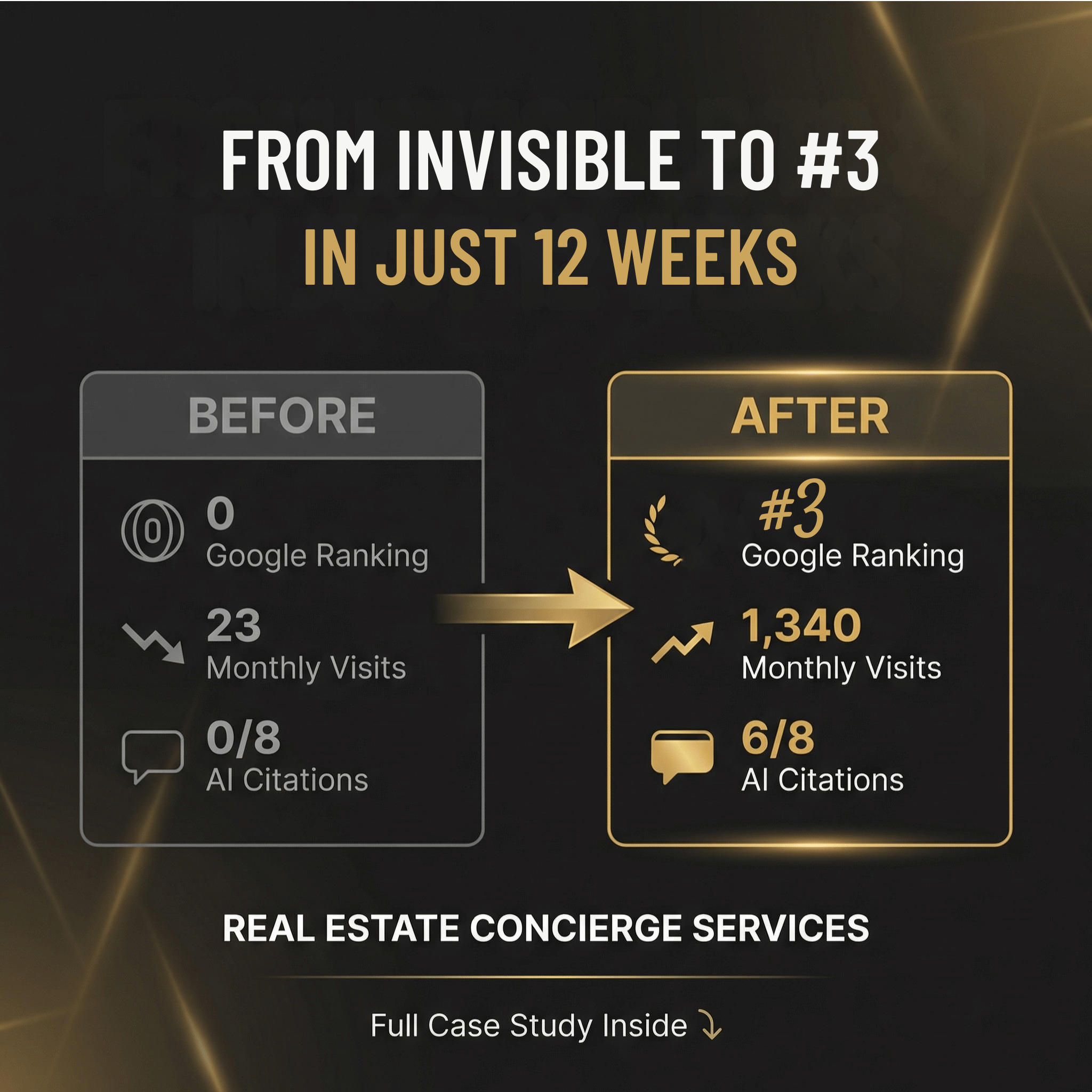
Case Study: From Invisible to #1 — How Agent Ken Dominated Local Search and AI in 12 Weeks

Case study from RECSC, from invisible to #3 in 12 weeks
Case Study: From Invisible to #3 in 12 weeks

The Starting Point: Completely Off the Map

Case Study Metrics at the start of campaign

When Ken came to Real Estate Concierge Services, he had been a licensed agent in Mooresville, NC (Lake Norman) for three years. He was closing 8-10 deals a year — decent, but entirely referral-dependent. His digital presence was, to put it bluntly, nonexistent.

Here is what we were working with on Day 1:


The Strategy: Three Pillars, Twelve Weeks

We built Ken's visibility strategy around three pillars that compound on each other: local search dominance (Google Business Profile + reviews), content authority (weekly blogs + relocator hub), and AI search positioning (structured content designed to be cited by large language models).

Pillar 1: Google Business Profile — The Foundation

Weeks 1-2 were entirely focused on building Ken's GBP from scratch. We did not just "claim" a listing — we engineered it.

We wrote a keyword-rich business description that naturally incorporated "Mooresville NC real estate," "Lake Norman homes for sale," "waterfront properties Lake Norman," and "relocation specialist Mooresville." We uploaded 47 high-quality photos in the first week alone — exterior shots of listings, neighborhood landmarks, Lake Norman waterfront views, Ken at local businesses, and community events. Each photo was geotagged and captioned with location-specific keywords.

We set up every available GBP feature: services (buyer representation, seller listing, relocation assistance, investment properties), products (free home valuation, buyer consultation, relocation guide), Q&A (pre-populated with 12 common questions about the Mooresville and Lake Norman market), and weekly GBP posts that we maintained throughout the 12 weeks.


The review engine was the game-changer. We created a simple review request system for Ken: a text message template he sent to every past client, every closing, and every positive interaction. The template linked directly to his Google review page — no friction, no confusion. Ken committed to sending 5 review requests per week.

By Week 8, Ken had more reviews than 4 of the top 5 agents in the Mooresville GBP pack. By Week 12, he had the highest review count AND the highest rating in his local market.


Pillar 2: Content Authority — The Relocator Hub and Weekly Blogs

Weeks 2-4 focused on building Ken's content engine. We created a dedicated relocator hub on his website — a comprehensive resource page targeting people moving to the Lake Norman and Mooresville area.

The relocator hub included seven core pages:

"Moving to Mooresville, NC: The Complete 2026 Guide" covered cost of living comparisons (Mooresville vs. Charlotte, vs. national average), school district breakdowns (Mooresville Graded School District ratings, enrollment numbers, notable programs), neighborhood profiles (Downtown Mooresville, The Point, Morrison Plantation, Northington, Curtis Pond), commute times to Charlotte (I-77 corridor analysis, typical drive times by neighborhood), and local lifestyle highlights (Lake Norman access, restaurants, breweries, the NASCAR connection).

"Lake Norman Waterfront Homes: What Buyers Need to Know" addressed dock permits, HOA regulations for waterfront communities, price ranges by cove and location, flood zone considerations, and seasonal market trends for lakefront properties.

We published the remaining five hub pages over Weeks 3-4, each targeting a specific long-tail keyword cluster:

Starting in Week 3, we launched a weekly blog cadence. Every Tuesday, a new post went live — each one targeting a specific question that potential buyers and relocators were searching for. The blog topics were selected using a combination of Google's "People Also Ask" data, Perplexity's trending queries, and keyword research from Ahrefs.


Here is the 12-week blog calendar we executed:

Each blog post followed a specific structure designed for both Google and AI search: a direct answer to the query in the first paragraph (for featured snippets and AI citations), structured headers using H2 and H3 tags, local data and statistics with cited sources, internal links to the relocator hub pages, and a clear CTA to contact Ken.


Pillar 3: AI Search Positioning — The Invisible Advantage

This is where the strategy separated Ken from every other agent in his market. Starting in Week 1, we identified 8 AI search queries that a potential buyer or relocator would ask ChatGPT, Perplexity, or Google's AI Overview:

6 out of 8 queries cited Ken or his content by Week 12. The two misses (queries 5 and 8) were dominated by large media outlets (Niche.com and Realtor.com) — but even on those, Ken's blog posts appeared in the source links that the AI models referenced.


The AI positioning strategy was not separate from the content strategy — it was embedded in it. Every blog post and hub page was written with AI citation in mind:

We used direct, authoritative answer structures in the opening paragraph of every post. Instead of "In this article, we'll explore..." we wrote "Mooresville, NC is one of the fastest-growing towns in the Charlotte metro, with a median home price of $425,000 and a population that has grown 23% since 2020." AI models pull from content that directly answers questions.

We embedded structured data markup (Schema.org) on every page — LocalBusiness schema on the homepage, FAQPage schema on the relocator hub, Article schema on every blog post, and RealEstateAgent schema on Ken's about page. This gave AI crawlers clean, parseable data about who Ken is and what he covers.

We built topical authority through internal linking. Every blog post linked to at least 2 other blog posts and 1 relocator hub page. The hub pages linked to each other and to the blog. This created a content web that signaled to both Google and AI models: "Ken Mercer is the definitive source for Mooresville and Lake Norman real estate information."

The Results: 12 Weeks, By the Numbers


The Revenue Impact

Ken's average commission per transaction in the Lake Norman market is approximately $8,200. During the 12-week engagement, he closed 4 deals that originated directly from his new digital presence — 2 from GBP inquiries, 1 from a blog post lead, and 1 from a relocator who found his hub page through a ChatGPT recommendation.


Ken's investment in the 12-week program was $4,800. His return on investment was 583% in the first 12 weeks alone — and the assets we built (GBP, blog posts, relocator hub, review engine) continue generating leads every month without additional spend.


The Compounding Effect: What Happened After Week 12

The most important thing about Ken's results is that they did not stop at Week 12. The content, the GBP, and the AI citations continue to compound. At the 6-month mark (Week 26), Ken's numbers had grown to:

Ken went from closing 8-10 referral-dependent deals per year to being on pace for 22+ deals in 2026, with more than half coming from his digital presence. He no longer wonders where his next client is coming from.


Key Takeaways for Agents

You do not need to be a tech expert. Ken did not write a single blog post himself. He did not set up his own GBP. He did not learn Schema.org markup. He showed up, sent review requests, and let the system work. The strategy was built and executed by Real Estate Concierge Services — Ken just had to say yes.

AI search is not the future — it is happening right now. One of Ken's 4 deals came directly from a ChatGPT recommendation. That buyer typed "best real estate agent in Mooresville NC" into ChatGPT, and Ken's name came up. That buyer never would have found Ken through a traditional Google search, a Zillow ad, or a cold call. AI search is a new channel, and most agents are not even in the game yet.

Content compounds. The blog post Ken published in Week 3 ("Is Mooresville NC a Good Place to Live?") is still his #1 traffic driver at the 6-month mark. It generates 340+ organic visits per month and has been cited by Perplexity 14 times. One blog post, written once, working forever.

Reviews are the multiplier. Ken's GBP ranking jumped from Page 3 to #1 largely because of his review velocity. Google's local algorithm heavily weights recent, frequent reviews. Ken went from 2 stale reviews to 27 fresh ones in 12 weeks — and that velocity is what pushed him past agents who had been in the market for 15+ years.

The agents who start now win. Ken's competitors in Mooresville are still not doing this. Most of them have a GBP with 5 reviews and no posts. None of them have a relocator hub. None of them are optimizing for AI search. Ken got a 12-week head start, and that head start compounds every single day.

Ready to Build Your Visibility Engine?

Ken's transformation was not luck, and it was not magic. It was a system — the same system we build for every agent we work with at Real Estate Concierge Services.

If you are tired of being invisible, if you are tired of watching agents with half your talent outrank you online, if you are ready to show up where your clients are actually searching — we should talk.

Start with the Google Visibility Audit or Visibility Foundation to see where you stand, or access our Real Estate Concierge Marketing Hub and upgrade to All Access for the full playbook, templates, and tools that powered Ken's results.

Drop your info below if you want weekly value bombs (30 day content calendar, Visibility Guide and Checklist, Case Studies, ChatGPT prompts for realtors, Listing Launch Kits, and much more!

Read More
Marketing Strategy, SEO & Visibility Emily Wyatt Marketing Strategy, SEO & Visibility Emily Wyatt

The Realtor Visibility Sprint: 7 Days to Fix Your Google Presence (and Convert More Leads)

Most Realtors are doing “all the things” and still not getting consistent inbound leads. This 7-day visibility sprint shows you exactly what to fix on your Google Business Profile, how to ask for reviews that help you rank, and the follow-up script that turns open house conversations into appointments.

If you are posting consistently, networking, hosting open houses, and still not getting predictable inbound leads, you do not have a work ethic problem.

You have a visibility problem.

In 2026, effort does not equal opportunity if people cannot find you at the exact moment they are searching. And that moment is usually on Google.

This post is a step-by-step sprint you can run in under an hour a day. It is designed to do two things:

  1. Get you found more often in local search

  2. Convert more of the leads you are already meeting (without chasing)

If you want the quick version: optimize your Google Business Profile, collect reviews that include location and outcomes, and stop sending follow-ups that end the conversation.

Let’s get you set up.

What “Visibility” Actually Means for Realtors

Visibility is not “posting more.” Visibility is being discoverable when intent is high.

Examples of high-intent searches:

  • “Realtor near me”

  • “moving to [city]”

  • “best neighborhoods in [city]”

  • “sell my house in [city]”

  • “[city] waterfront homes agent” (Lake Norman friends, I’m looking at you)

Google, and increasingly AI search results, rely on consistent business signals:

  • accurate business info

  • strong reviews with context

  • clear services

  • locally relevant content

If your online presence is scattered or vague, Google cannot confidently put you in front of the right people.

The 7 Day Visibility Sprint

Do these in order. Each day builds on the last.

Day 1: GBP Foundation

Open your Google Business Profile and check these three things:

1) Primary category
Be specific. “Marketing consultant” and “real estate consultant” are not the same. Your category impacts what you show up for.

2) Services
Fill out your services list with what you want to get hired for. Not what sounds fancy.

Examples:

  • Real estate marketing consulting

  • Real estate lead generation support

  • Google Business Profile optimization

  • Listing launch marketing

  • Relocation marketing campaigns

  • CRM setup and lead nurturing (HubSpot)

3) Service areas
Set service areas based on where you want business, not where you happen to be sitting when you create the profile.

Quick win: add your top 5 target areas and keep them consistent across your website and socials.

Day 2: Fix Your Business Description (This is a rankings and conversion lever)

Most GBP descriptions are either bland or stuffed with keywords. Both are a miss.

Use this structure:

Line 1: Who you help + where
Example: “Outsourced Operations and Marketing for Realtors in Raleigh and Lake Norman.”

Line 2: What you actually do
Example: “I help agents get found on Google, convert leads through follow-up systems, and turn listings into content that drives calls.”

Line 3: Proof or differentiator
Example: “Boutique, hands-on support. No fluff. Clear deliverables.”

Line 4: CTA
Example: “Message me for a quick visibility audit.”

Day 3: Photos That Build Trust and Signal Activity

Google rewards fresh activity. People reward proof.

Upload 10 new photos this week:

  • a clean headshot

  • you working, laptop, on-site, meeting, content creation

  • screenshots of results (blur any sensitive info)

  • a simple branded graphic (checklist, script, framework)

  • local photos (Raleigh, Lake Norman landmarks, events, streetscapes)

Tip: upload 1 to 2 photos weekly going forward. Consistency wins.

Day 4: The Review Sprint (Reviews that rank are not generic)

“Highly recommend” reviews are nice, but they do not help you rank like reviews with context.

Ask for reviews that include:

  • location (city, neighborhood)

  • service (buying, selling, relocation, marketing support)

  • outcome (what improved, what result happened)

Copy/paste review ask:
“If you’re comfortable, could you mention the area you’re in, what I helped you with, and the result? That helps local agents find me when they need the same support.”

Five prompts to make it easy for them:

  1. Mention the city or neighborhood

  2. Mention the service (GBP, content, CRM, listing launch, etc.)

  3. Share the problem you were trying to solve

  4. Share what felt different about working together

  5. Share the result

Day 5: Build One Website Page That Actually Converts

Pretty websites do not convert if they do not answer the right questions.

Minimum viable “conversion” setup:

  • clear positioning

  • proof

  • next step

Create one page that targets a real, high-intent search:

Option A: “Google Business Profile Optimization for Realtors”
Include:

  • who it’s for

  • what’s included

  • common mistakes

  • timeline

  • CTA to book

Option B: “Relocation Marketing for Realtors”
Include:

  • what you build (guides, neighborhood content, visibility assets)

  • examples of deliverables

  • CTA

If you already have a services page, your job is to add one page that is laser-focused, not another general overview.

Day 6: Create a 3 Area Content Map (The simplest local authority play)

Pick 3 areas you want to own. Then write 3 pieces of content.

For each area:

  • Who it’s perfect for

  • Who should skip it

  • The tradeoff nobody says out loud

This is the kind of content that gets saved, shared, and ranked.

Day 7: Publish One “Start Here” Offer Post and Pin It

This is your lead-capture post. It should be simple and specific.

Example:
“If you’re a Realtor and your Google Business Profile is not producing calls, comment AUDIT and I’ll send you the top 3 fixes that will move the needle fast.”

Pin it on Facebook. Feature it on LinkedIn. Add it to your GBP as an Offer post.

Bonus: The Open House Follow-Up Script That Converts

Most agents send follow-ups that end the conversation.

Use a follow-up that asks one smart question:

Copy/paste:
“Hey [Name], thanks again for coming by today. Quick question: what’s the one thing you’re hoping your next move fixes or improves? More space, shorter commute, better schools, walkability, less maintenance, or something else? If you tell me that, I’ll send you 3 options that match, plus what you should watch for before you fall in love with the wrong house.”

Why it works:

  • it is about their life, not your schedule

  • it asks one easy question

  • it earns the right to send more value

If You Want Me to Check Your Visibility

I run a quick mini audit and send you:

  • 3 quick fixes

  • the 1 thing to change first

  • what to post for the next 2 weeks

Comment AUDIT or message me with your market.

FAQ

How long does GBP take to improve?
If you fix categories, services, description, and start consistent posting and reviews, you can see movement within weeks. Real stability comes from consistency.

Do I need to post daily on GBP?
No. Weekly is fine. Consistent is the point.

What matters more, website or GBP?
GBP usually drives the fastest local results. Your website supports conversions and longer-term ranking.

Are generic reviews still helpful?
Yes, but specific reviews help you rank and convert better.


Read More
Emily Wyatt Emily Wyatt

The Realtor’s Catch‑22: You Need Marketing to Sell Homes, but You Need Sales to Afford Marketing — Here’s How to Break the Cycle

Stuck in the marketing catch‑22? You need marketing to sell homes but sales to fund your marketing. Discover how to break the cycle with smart strategies, AI tools, and bold storytelling.

Catch 22 of Realtors affording Marketing

Catch 22 graphic depicting the struggle for agents needing marketing to get listings but needing listings to afford marketing

If you’ve ever felt trapped by the paradox of needing marketing to get listings and needing listings to pay for marketing, you’re not alone. A recent LinkedIn post showed that 86 % of agents stay with a brokerage because of the marketing support they receive — yet most feel abandoned when it comes to actual strategy. That gap is exactly why so many realtors are stuck in neutral.

Why traditional marketing falls short

Too many agents throw money at generic ads and lead‑generation services that promise the moon and deliver dusty email lists. Marketing consultant Carter Vincentini didn’t mince words when he said “95 % of real estate marketing is trash”. Leads like “I love this area and want to serve you” rarely convert because they lack specificity and authenticity. Without a clear brand story and strategic messaging, your posts are just more noise.

The data confirms the shift

New survey research from The Real Brokerage found that 88 % of agents are already using AI to enhance marketing assets, property descriptions, social media posts and virtual stagings. Even more telling, 68 % of agents say AI saves them significant time, and 14 % credit AI tools with improving marketing effectivenesss. The message: automation isn’t an option any more — it’s the foundation. The remaining gap is strategy and storytelling.

Break out of the marketing catch‑22

Here’s how to reclaim control of your pipeline without burning cash:

  1. Lead with value, not vanity. Instead of boilerplate posts, share insights specific to your market: neighborhood changes, upcoming zoning decisions, or how national interest‑rate shifts affect local buyers. Demonstrate that you know more than the MLS; you understand how homes fit into people’s lives.

  2. Adopt AI — but make it personal. Use AI tools (like ChatGPT) to draft property descriptions, video scripts and email sequences, but always inject your authentic voice. AI saves time; your human touch seals the deal.

  3. Invest in content that compounds. Stop throwing money at single‑use ads. Build evergreen guides, checklists and explainer videos that answer common questions (“How do I time the market?” or “What does a pre‑inspection really save me?”). These assets position you as a trusted advisor and can be repurposed across Instagram, TikTok, LinkedIn and email.

  4. Join the conversation where it’s happening. Facebook groups like Real Estate Agent Referral Network & Marketing Tips have hundreds of thousands of members seeking advice. Show up. Answer questions. Share your insights without pitching. When agents see you as a resource, you become their go‑to when they’re finally ready for professional support.

  5. Build strategic partnerships. Align with local businesses, mortgage brokers and home‑service providers. Co‑host webinars or Instagram Lives that tackle topics your audience cares about (e.g., staging on a budget, understanding appraisal gaps). Combined audiences multiply exposure without multiplying costs.

Final take

Marketing isn’t a cost centre; it’s an investment. The real catch‑22 isn’t a lack of budget, it’s a lack of strategy. When you master authentic storytelling, adopt smart tools and show up consistently, your marketing not only pays for itself — it becomes your unfair advantage.

Ready to stop wasting money on ads that don’t convert? Let’s design a marketing strategy that actually works — and break your business out of its vicious cycle.

Read More