5 Marketing Systems Every Solo Agent Needs Before They Hire a Team
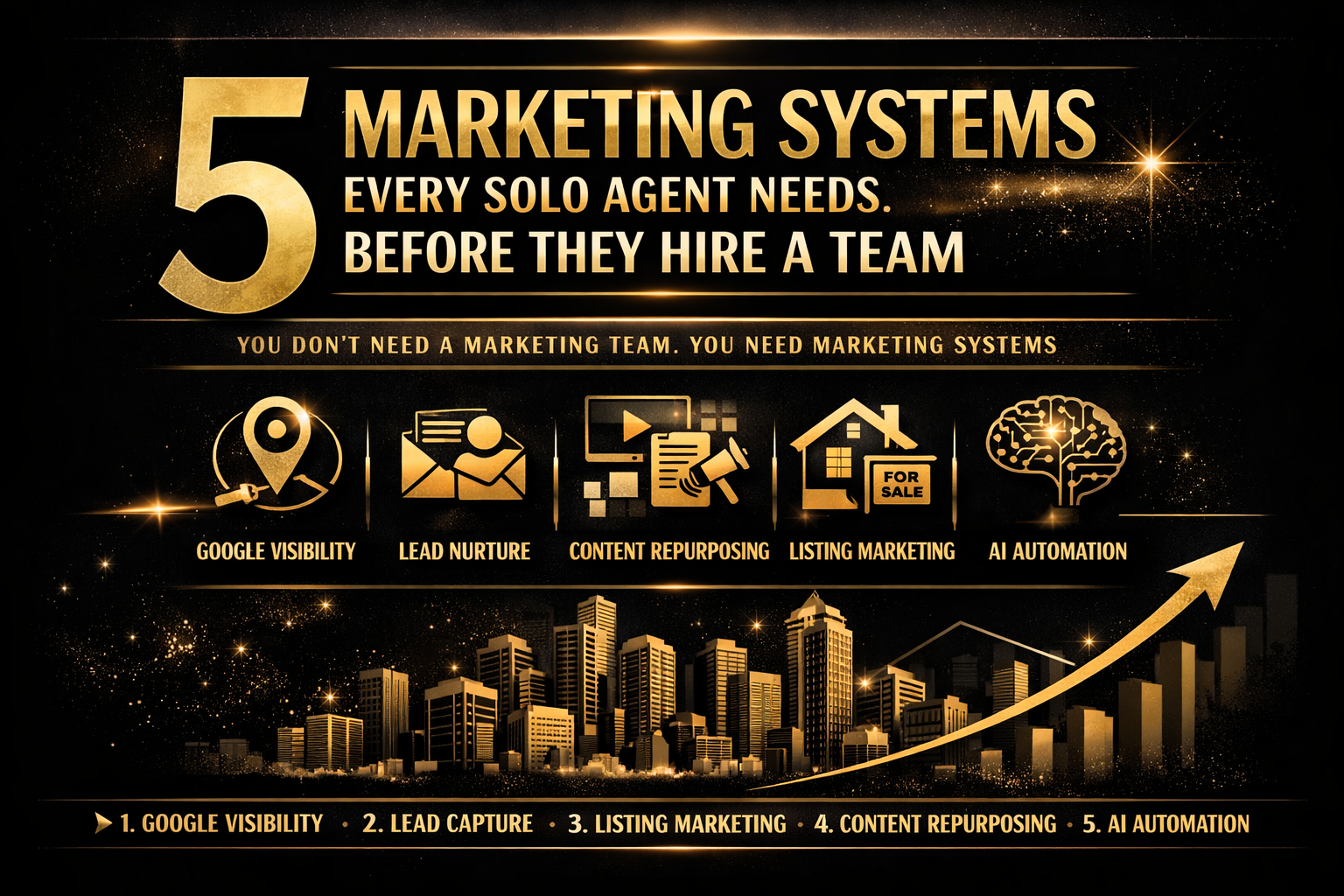
Five Marketing Systems every solo agent needs before they hire a team. You don’t need a marketing team, you need a marketing system.
Let me save you a very expensive mistake.
You're a solo agent doing $3M-$8M in volume. You're busy. You're closing deals. And somewhere between your 47th showing and your 12th "just checking in" text, you think: I need to hire someone to handle my marketing.
So you hire a social media manager. Or a VA. Or a "marketing assistant" who's really just your nephew's girlfriend who knows how to use Canva.
And three months later, you've spent $3,000-$6,000 and your marketing looks exactly the same — or worse, it looks like someone else's brand wearing your name tag.
Here's what nobody tells you: you don't need a team. You need systems. And until you have the right systems in place, adding people just adds chaos.
I've worked with dozens of agents across Raleigh and Lake Norman, and the pattern is always the same. The agents who scale smoothly aren't the ones who hired first — they're the ones who systematized first. Here are the five marketing systems every solo agent needs locked in before they even think about bringing on help.
System 1: Your Google Visibility System
If you don't have a system for showing up on Google, nothing else matters. Not your Instagram. Not your email list. Not your fancy new headshots.
Google is where intent lives. When someone searches "homes for sale in North Hills Raleigh" or "best listing agent Lake Norman," they're not browsing — they're buying. And if you're not in the top three results (or the Map Pack), you're invisible to the highest-intent leads in your market.
Your Google Visibility System includes three components. First, a fully optimized Google Business Profile that gets updated weekly — not set up once and forgotten. Second, a website with dedicated pages for every neighborhood and service area you work, each targeting specific local keywords. Third, a review generation process that consistently brings in fresh five-star reviews with keyword-rich content.
This system should run on autopilot once it's built. You spend 30 minutes a week posting to your GBP and responding to reviews. Your website pages work 24/7 in the background. And your review process triggers automatically after every closing.
Most agents skip this system entirely because it's not "sexy." It doesn't get likes. It doesn't go viral. But it generates more consistent, high-quality leads than any social media strategy ever will.
System 2: Your Lead Capture and Nurture System
Here's a question that makes most solo agents uncomfortable: what happens when someone visits your website?
If the answer is "nothing" — if there's no lead magnet, no email capture, no follow-up sequence — then you're paying for traffic (whether through SEO, ads, or social) and letting it walk right out the door.
Your Lead Capture and Nurture System has two parts.
The capture is a valuable piece of content that someone will trade their email for. This could be a neighborhood guide, a home seller's checklist, a market report, or a "What's My Home Worth" tool. The key is that it has to be genuinely useful — not a thinly veiled sales pitch disguised as a PDF.
The nurture is an automated email sequence that delivers value over time and positions you as the obvious choice when they're ready to buy or sell. This isn't a drip campaign that sends "just checking in!" every two weeks. It's a strategic sequence that educates, builds trust, and makes a clear case for why you're different.
A basic nurture sequence looks like this: an immediate delivery email with the resource they requested, followed by a value email two days later sharing a market insight or tip, then a story email on day five featuring a recent client success, a positioning email on day eight explaining what makes your approach different, and finally a soft CTA on day twelve inviting them to book a call or reply with questions.
Five emails. Automated. Running in the background while you're at showings. This is the system that turns website visitors into actual conversations — and most solo agents don't have it.
System 3: Your Content Repurposing System
The biggest time trap in real estate marketing is creating content from scratch every single day. You don't need to do that. You need a repurposing system.
Here's how it works: you create one core piece of content per week. That's it. One blog post, one video, or one long-form social post. Then you break it into smaller pieces that feed every other channel.
One blog post becomes a LinkedIn article (copy-paste with minor edits), three to four social media posts pulling key quotes or stats, one email newsletter highlighting the main takeaway, one Google Business Profile post with a local angle, and one short-form video script if you're doing video.
That's six to seven pieces of content from one hour of writing. Without a repurposing system, you'd spend six to seven hours creating each piece individually — and most of them would be worse because you'd be rushing.
The system part is important. This isn't about being creative in the moment. It's about having a repeatable process: write the core piece on Monday, break it down on Tuesday, schedule everything on Wednesday. Same rhythm every week. Same process. Same result.
When you eventually hire someone to help with marketing, this system is what you hand them. Without it, you're asking them to figure out your voice, your strategy, and your workflow from scratch. With it, you're handing them a machine that just needs someone to press the buttons.
System 4: Your Listing Marketing System
Every listing is a marketing event. Not just for the seller — for you.
Most agents treat listing marketing as a checklist: take photos, write a description, put it on MLS, post it on social media, done. But the agents who build their brand through listings treat every single one as a campaign.
Your Listing Marketing System should include a pre-listing package that wows the seller before you even get the contract (this is also your listing presentation differentiator), a professional photography and staging coordination process, a property-specific landing page or single-property website, a social media launch sequence (coming soon, just listed, open house, price update, under contract, just sold), an email blast to your database with the new listing, a neighborhood door-knock or direct mail piece, and a post-sale case study that you add to your website.
The key word here is "system." Every listing goes through the same process. You're not reinventing the wheel each time. You have templates, timelines, and checklists that make every listing look like a luxury launch — even if it's a $250K starter home.
This system does double duty: it impresses your sellers (which leads to referrals) and it builds your brand in the market (which leads to more listings). It's the single highest-ROI marketing system a solo agent can build.
System 5: Your AI Implementation System
This is the one that separates 2026 agents from 2020 agents.
AI isn't replacing real estate agents. But agents who use AI are replacing agents who don't. And the difference isn't about using ChatGPT to write a listing description — it's about building AI into your daily workflow so you operate at twice the speed with half the effort.
Your AI Implementation System covers four areas.
Content creation means using AI to draft blog posts, social captions, email sequences, and listing descriptions — then editing them in your voice. This cuts content creation time by 60-70%.
Client communication involves AI-powered templates for follow-ups, check-ins, and market updates that feel personal but take seconds to customize. You're not writing every email from scratch anymore.
Market research is about using AI to analyze market data, pull comparable sales, generate neighborhood insights, and create market reports in minutes instead of hours.
Lead qualification means AI chatbots or automated response systems that engage website visitors, answer common questions, and route serious inquiries to you — so you're not spending time on tire-kickers.
The agents I work with who implement even two of these four areas consistently report saving 10-20 hours per month. That's 10-20 hours you can spend on dollar-productive activities — or, you know, actually having a life.
The system part matters here too. It's not about using AI randomly when you remember. It's about building AI into your standard operating procedures so it becomes automatic. Your Monday content creation session uses AI. Your Friday follow-up batch uses AI templates. Your monthly market report is AI-assisted. Same process, every time.
The Order Matters
If you're reading this and thinking "I need all five," you're right. But don't try to build them all at once. That's how you burn out and end up with five half-built systems that don't work.
Here's the order I recommend:
Start with System 1 (Google Visibility). This is your foundation. It takes 2-3 weeks to fully build and starts generating leads almost immediately. Everything else builds on top of this.
Then build System 2 (Lead Capture and Nurture). Once you're getting traffic from Google, you need somewhere for those leads to go. This takes about a week to set up and runs on autopilot after that.
Next, add System 4 (Listing Marketing). Your next listing is your next opportunity to build this system. Create the templates and checklists once, then refine them with each listing.
Then layer in System 3 (Content Repurposing). Once you have your Google pages and your nurture sequence, you need a steady stream of content to feed them. The repurposing system makes this sustainable.
Finally, implement System 5 (AI). This is the accelerator. Once your other systems are in place, AI makes everything faster and better. But AI without systems is just faster chaos.
When You're Ready to Hire
Once all five systems are running, hiring becomes easy. You're not asking someone to "do your marketing." You're handing them documented systems with clear processes, templates, and expectations.
Your first hire should be someone who can run Systems 3 and 4 — content repurposing and listing marketing. These are the most time-intensive and the easiest to delegate because the creative decisions are already made. The hire just needs to execute the system.
Your Google Visibility and Lead Nurture systems should stay under your control (or be managed by a specialist) because they're too important to hand to a generalist.
And your AI system? That's yours. It's your competitive edge. Learn it, own it, and use it to stay two steps ahead of every other agent in your market.
The Bottom Line
You don't need a marketing team. You need marketing systems. Build the five systems outlined above, and you'll have a marketing operation that runs with minimal daily effort, generates consistent leads, and scales with your business.
Then — and only then — hire someone to help you run it.
The agents who build systems first and hire second always outperform the ones who do it the other way around. Always.
Emily Wyatt is the Founder of Real Estate Concierge Services Company LLC. She builds marketing systems for real estate agents and brokerages across Raleigh and Lake Norman — so they can stop guessing and start getting found.
Not sure which system to build first? Take the free Marketing Scorecard [blocked] to see where your biggest gaps are, or book a strategy call and we'll map it out together.
Part of The Agent Edge series:
What Is a Fractional Marketing Partner?
What is a Fractional Marketing Partner?
(And Why Raleigh Real Estate Agents Need One)
If you're a real estate agent in Raleigh, Durham, or the greater Triangle area, you've probably had this thought at least once: I know I need marketing help, but I can't afford a full-time hire — and I don't trust another agency to understand my business.
You're not wrong on either count. A full-time marketing director costs $70,000 to $120,000 a year before benefits. And most agencies hand you a cookie-cutter social media package that looks exactly like every other agent's feed in Wake County.
There's a third option that's gaining serious traction in the North Carolina real estate market — and it might be exactly what your business needs right now.
It's called a fractional marketing partner.
So What Exactly Is a Fractional Marketing Partner?
A fractional marketing partner is a senior-level marketing professional who embeds into your business on a part-time or contract basis. They bring the same strategic thinking, execution skills, and accountability as a full-time marketing director — without the full-time salary, benefits, or overhead.
Think of it this way: you get a marketing department without building a marketing department.
The word "fractional" simply means you're getting a fraction of their time, but the full depth of their expertise. Unlike a freelancer who completes one-off tasks, or an agency that manages your accounts from a distance, a fractional marketing partner actually learns your business, your voice, your market, and your goals — then builds and executes a strategy around them.
For real estate professionals in Raleigh and the surrounding Triangle market, this model is particularly powerful because real estate marketing isn't generic. It requires someone who understands local search behavior, neighborhood-level positioning, seasonal market shifts, and the way buyers and sellers in Wake County, Johnston County, and the Lake Norman area actually make decisions.
How Is This Different from Hiring an Agency?
This is the question every agent asks, and it's a fair one. Here's the honest breakdown:
Difference between a Traditional Marketing Agency, a Freelancer, and a Fractional Marketing Partner
The biggest difference is ownership. An agency manages your marketing. A fractional marketing partner owns it alongside you. They're in the weeds — adjusting your Google Business Profile strategy when the algorithm shifts, rewriting your listing descriptions when a neighborhood heats up, building email sequences that actually nurture leads instead of collecting dust in a CRM.
What Does a Fractional Marketing Partner Actually Do?
The scope depends on your business, but for real estate agents and small brokerages in the Raleigh-Durham market, a fractional marketing partner typically handles some combination of the following:
Local SEO and Google Business Profile optimization. This is where most agents leave the biggest opportunity on the table. A fractional partner ensures your GBP is fully optimized, posting consistently, and ranking in the local Map Pack for searches like "real estate agent near me" and "homes for sale in [neighborhood]." In a market like Raleigh — where new residents are relocating from the Northeast and West Coast every week — showing up in local search isn't optional. It's survival.
Content strategy and creation. Blog posts, social captions, email newsletters, listing descriptions, neighborhood guides, market updates — all written in your voice, optimized for search, and designed to position you as the go-to agent in your area. Not generic templates. Content that sounds like you actually wrote it.
Brand positioning and messaging. Most agents in the Triangle market sound exactly the same. "I'm passionate about helping buyers and sellers achieve their real estate dreams." A fractional partner helps you find the message that actually differentiates you — the one that makes a relocating family in Cary or a first-time buyer in North Raleigh choose you over the 47 other agents in their search results.
Email marketing and lead nurturing. Capturing leads is only half the battle. A fractional partner builds automated email sequences, follow-up workflows, and re-engagement campaigns that keep you top of mind without requiring you to manually send emails every week.
Website and digital presence management. Your website, your landing pages, your online profiles — everything a potential client sees before they ever call you. A fractional partner keeps it all current, optimized, and converting.
AI integration and workflow automation. The smartest agents in Raleigh right now are using AI to generate content, automate follow-ups, and streamline their marketing operations. A fractional partner who understands AI implementation can build these systems for you — saving you hours every week while keeping everything on-brand.
Why This Model Works So Well for Real Estate Agents in Raleigh
The Raleigh-Durham-Chapel Hill Triangle is one of the fastest-growing metro areas in the country. The population has grown by over 20% in the last decade, and the influx of tech workers, remote professionals, and relocating families has created a real estate market that's both competitive and opportunity-rich.
Here's the problem: most agents in this market are competing on the same platforms, with the same messaging, using the same tired strategies. The agents who are winning — the ones consistently generating inbound leads and building recognizable local brands — are the ones who've invested in marketing that's actually strategic.
But strategic marketing requires expertise, consistency, and time. And if you're a solo agent or running a small team, you don't have the bandwidth to do it yourself and you don't have the budget to hire a full marketing department.
That's the gap a fractional marketing partner fills.
You get senior-level marketing leadership and execution at a fraction of the cost. You get someone who understands the Raleigh market — who knows that North Hills buyers search differently than Holly Springs buyers, that the Lake Norman market has its own rhythm, and that Wake County's growth trajectory creates unique positioning opportunities for agents who move fast.
Who Should Consider a Fractional Marketing Partner?
This model isn't for everyone, and that's by design. A fractional marketing partner is the right fit if you're:
A solo agent doing $3M+ in annual volume who knows marketing matters but can't justify a full-time hire. You need strategy and execution, not just another tool or subscription.
A small brokerage or team in the Triangle that's outgrown DIY marketing but isn't ready for a six-figure marketing director. You need someone who can build systems that scale with your growth.
A top producer who's hit a ceiling and realizes that more cold calls and door knocking won't get you to the next level. You need a brand — and someone who can build it strategically.
A new-to-market agent relocating to Raleigh who needs to establish local authority fast. You don't have years to build organic visibility. You need someone who can accelerate your presence in Wake County from day one.
What It's Not
A fractional marketing partner is not a social media manager who schedules posts and calls it a day. It's not a virtual assistant handling admin tasks. And it's not a marketing agency running the same playbook for you that they run for 50 other clients.
It's a strategic partnership. Someone who sits on your side of the table, understands your revenue goals, and builds marketing systems designed to hit them.
How to Find the Right Fractional Marketing Partner in Raleigh
If you're exploring this model, here's what to look for:
Industry-specific experience matters. Real estate marketing is fundamentally different from SaaS marketing or e-commerce marketing. Your fractional partner should understand listing cycles, seasonal market patterns, local search behavior, and the way real estate consumers make decisions. Bonus points if they know the Raleigh-Durham market specifically.
Ask about their process, not just their portfolio. A good fractional partner will audit your current marketing, identify gaps, and build a phased strategy — not just show you pretty graphics from past clients. Ask how they'd approach your first 30 days.
Look for someone who can both strategize and execute. Some fractional CMOs only do strategy and hand off execution to your team. If you don't have a team, that's a problem. The best fractional marketing partners for solo agents and small brokerages can do both — build the plan and do the work.
Make sure they understand AI and modern tools. Marketing in 2026 looks nothing like marketing in 2020. Your fractional partner should be fluent in AI-powered content creation, automation workflows, CRM integration, and data-driven decision making. If they're still pitching you on "posting three times a week on Instagram," they're behind.
The Bottom Line
A fractional marketing partner gives you the marketing leadership and execution your real estate business needs — without the overhead of a full-time hire or the detachment of a traditional agency. For agents and brokerages in Raleigh, Durham, and the greater Triangle area, it's a model built for exactly the kind of growth this market demands.
You don't need more marketing tools. You don't need another subscription. You need a partner who understands your business, your market, and your goals — and who shows up every week to move the needle.
That's what a fractional marketing partner does.
Real Estate Concierge Services Company LLC offers fractional marketing partnerships for real estate agents and brokerages in Raleigh, Lake Norman, and across North Carolina. If you're ready to stop guessing with your marketing and start building a system that generates leads consistently, [book a free strategy call]
AI Implementation Without Selling Your Soul (or Sounding Like a Robot)
A solo real estate agent hated ChatGPT for reasons that were actually valid. She worried about ethics, authenticity, and sounding like a robot online. We didn’t argue with her or throw prompts at her. We set boundaries first, then installed a real system: voice lock, content workflow, lead capture, HubSpot follow up, GBP rhythm, and ops templates. The result was not “more content.” It was consistency, faster follow up, and a business that stopped starting from zero.
There’s a specific type of real estate agent I see all the time.
Smart. Busy. Good at what they do. Deeply relationship driven.
And completely allergic to anything that smells like generic marketing.
This agent did not just feel “meh” about AI. She hated it. Specifically ChatGPT. She thought it was wasteful. She worried it would turn her voice into bland copy. She did not want to become another cookie cutter realtor with captions that sound like a motivational poster.
Honestly? Fair.
But she also had a real business problem: she was constantly starting from zero.
So we didn’t teach her “how to use AI.”
We implemented it into her business like infrastructure.
Here’s exactly how.
The Client
Solo agent in North Carolina.
Busy schedule, great at serving clients, inconsistent marketing, scattered follow up, and a love hate relationship with content. When she posted, it worked. The issue was she could not do it consistently.
She also had strong objections to AI:
Environmental impact
Authenticity concerns
Fear of sounding robotic or salesy
“I don’t want to outsource my personality to a tool”
So we treated AI like a power tool, not a personality transplant.
The Problem
This was not a “she needs better captions” situation.
It was:
Not enough time
Too many decisions every day
Follow up living in her head
Content drought, then bursts of activity, then silence
Inconsistent visibility across Google and social
A constant feeling of being behind
She wasn’t failing.
She was overloaded.
And overload kills consistency.
The Objection (the part most people skip)
Most people try to overcome AI objections with a sales pitch.
We did not.
We validated them and built around them.
Her concern was simple:
“I don’t want robot content. I don’t want fake authenticity. And I don’t want to contribute to something I feel is unethical.”
So the first deliverable was not prompts.
It was boundaries.
The Approach
Step 1: We set boundaries first
Before we built a single workflow, we wrote down the rules:
AI supports, it does not impersonate.
Her stories stay hers.
No fake expertise, no made up local claims, no cringe persuasion language.
Short, intentional work sessions. No endless back and forth.
Every output must sound like her or it does not ship.
Once those boundaries were in place, her resistance dropped fast because she no longer felt like she was “selling out.”
Step 2: Then we built systems
Here is the truth: AI does not create results. Systems do.
AI becomes useful when it is attached to:
a clear voice
clear offers
clear lead flow
a repeatable weekly rhythm
So we built a machine that runs even when she is tired.
What We Implemented
This is what we installed into her business.
1) Voice Lock (so AI never sounds like a robot)
We built a “voice lock” with:
her tone and personality rules
her non negotiables
phrases to use often
phrases to never use
how she handles objections
how she talks to buyers and sellers in real life
Now AI had guardrails.
2) A prompt library that matched her actual business
Not “100 prompts for realtors.”
A functional library built around:
listings and open houses
buyer education
seller education
relocation
objections and follow up
past client reactivation
referral partner outreach
3) A weekly content workflow (one input becomes a full week of marketing)
We created a system where she gives one weekly input and gets:
short form video scripts
captions in her voice
Google Business Profile posts
one longer authority piece per month (blog or LinkedIn style)
plug and play calls to action
No daily reinvention.
4) Lead capture and follow up logic in HubSpot
This is where most agents lose money.
We set up:
lead categories (buyer, seller, relocation, open house, warm referral)
follow up templates for each category
sequencing logic so she always knows what to send next
Fast follow up, without sounding like an auto bot.
5) A Google Business Profile rhythm that compounds
We built a posting rhythm that supports visibility:
consistent posts
local content angles
clear CTAs
review request language that feels human
6) Ops templates to stop the mental load
AI is not just for marketing. It is for capacity.
We implemented:
listing launch checklist
client journey touchpoints
weekly CEO dashboard (what to do, who to follow up with, what to post)
This is what stopped the constant scramble.
The Results
Even without chasing vanity metrics, the impact was immediate.
Here are the results we saw within weeks:
Hours saved per week: typically 3 to 7+ hours regained because she stopped rewriting everything from scratch
Faster follow up: responses went from “when I remember” to same day or next day
Consistent posting: no more content droughts, just a predictable weekly rhythm
More inquiries: not because of magic, but because she was visible consistently
Less stress: she described it as “my brain feels quieter”
And the biggest shift?
She stopped treating marketing like emotional labor.
The Real Win
The win was not “AI made me a content machine.”
The win was:
she stopped starting from zero.
When you stop starting from zero:
you stop procrastinating
you stop disappearing online
you stop losing leads to slow follow up
you start showing up like you have a team
That is what implementation looks like.
Final Takeaway
If you hate AI, you’re not behind.
You’re discerning.
But the agents who win in the next few years will not be the ones who “use ChatGPT.”
They will be the ones who implement systems that protect their voice and make consistency inevitable.
If you want AI implemented into your real estate business in a way that feels:
ethical and intentional
human and voice protected
systemized, not gimmicky
Then the AI Implementation Sprint is for you.
Not sure what you need? Start Here
FAQ
1) Is it ethical to use ChatGPT in a real estate business?
It can be, if you use it intentionally. The key is transparency with yourself and your standards: do not fabricate facts, do not claim local expertise you do not have, do not mislead consumers, and do not let AI “speak for you” in a way that misrepresents who you are. In this case study, we used AI as a workflow tool (drafting, organizing, structuring, and systemizing) while keeping the agent’s real voice, real stories, and real professional judgment in control.
2) How do I use AI without sounding like a robot realtor?
You need a voice lock, not more prompts. A voice lock is a short set of rules that defines your tone, phrases you actually use, phrases you never use, and how you communicate with buyers and sellers in real life. Once that is in place, AI can help you draft faster, but your voice stays consistent and human.
3) What does “AI implementation” actually mean for a real estate agent?
Implementation means installing AI into your day to day workflow so it supports revenue and consistency. For most agents, that includes: a weekly content workflow, follow up templates and sequencing, a simple lead capture process, a Google Business Profile posting rhythm, and ops checklists that reduce mental load. The goal is not more content. The goal is a business that does not rely on motivation.
4) Will AI replace my marketing person or assistant?
AI can replace a lot of repetitive drafting and organizing tasks, but it does not replace strategy, judgment, compliance, local knowledge, or relationship building. The best use is to treat AI like an assistant that accelerates your thinking and execution, while you stay the decision maker.
5) What should I implement first if I’m overwhelmed?
Start with follow up and a weekly content workflow. Follow up stops lead leakage immediately, and a weekly workflow eliminates the “start from zero” problem. Once those two are stable, add ops templates and a consistent Google Business Profile rhythm to compound visibility.
6) How long does it take to see results from AI implementation?
Most agents feel relief quickly because decision fatigue drops immediately. Visible consistency (posting and follow up) usually improves within the first couple of weeks if the systems are simple and repeatable. Lead outcomes depend on your market, offer, and existing visibility, but implementation is the fastest path to showing up consistently enough for leads to find you.
What Realtors Get Wrong About SEO (And Why It’s Costing You Listings)
Most Realtors are following outdated advice that quietly kills their visibility. This breakdown explains what actually works in local SEO today, why blogging and social media alone aren’t enough, and how weak infrastructure is costing agents listings without them realizing it.
Image of desk and the words What Realtors Get Wrong About SEO
What Realtors Get Wrong About SEO
Let’s clear something up.
SEO is not broken.
Google is not “too competitive.”
And your market is not the problem.
What is happening is that most Realtors are following outdated, incomplete, or flat out wrong advice about SEO. And it is quietly costing them visibility, leads, and listings.
If you have ever said “SEO doesn’t work for me,” this is probably why.
Mistake #1: Thinking Blogging Alone Equals SEO
This is the biggest misconception I see.
Agents are told:
“Just write blogs.”
“Content is king.”
“Post weekly and Google will reward you.”
Blogging helps. But blogging by itself does not equal SEO, especially for local businesses.
If your blog is not connected to:
Local intent
Your Google Business Profile
Clear services
Structured visibility signals
Then you are creating content that floats around the internet without a job.
Blogs do not rank businesses.
Systems do.
Mistake #2: Treating SEO Like a One Time Setup
Most agents approach SEO like a checklist.
Website done.
Google profile claimed.
Keywords added once.
Move on.
That is not how Google works anymore.
Google rewards:
Consistent activity
Ongoing updates
Fresh signals that confirm you are active and relevant
If your Google presence looks frozen in time, Google assumes your business might be too.
SEO is not a set it and forget it task.
It is an ongoing signal of legitimacy.
Mistake #3: Thinking SEO Is Just Keywords
Keywords matter, but they are not the whole picture.
What Google actually cares about is:
Who you serve
Where you serve them
What problem you solve
Whether people engage with your business
You can stuff keywords into a page all day long, but if your profile, website, and content do not clearly answer those questions, Google will not trust you enough to show you.
SEO today is about intent and clarity, not keyword gymnastics.
Mistake #4: Believing Social Media Replaces SEO
This one is costing agents the most money.
Social media builds awareness.
SEO captures demand.
Posting on Instagram does not help when someone searches “Realtor near me” at 10 p.m.
Your Google presence does.
Social content is rented attention.
Search visibility is owned real estate.
The strongest agents do not choose one or the other. They understand that each plays a different role.
Let’s clear something up.
SEO is not broken.
Google is not “too competitive.”
And your market is not the problem.
What is happening is that most Realtors are following outdated, incomplete, or flat out wrong advice about SEO. And it is quietly costing them visibility, leads, and listings.
If you have ever said “SEO doesn’t work for me,” this is probably why.
What Actually Works Right Now
Here is the part most people skip.
Modern local SEO works when:
Your Google Business Profile is active, complete, and accurate
Your services are clearly defined
You post consistently, even short updates
Your website supports local intent, not just branding
Your online presence sends the same message everywhere
This is not about tricks.
It is about making it easy for Google to understand and trust your business.
When that happens, visibility follows.
What You Should Do Next
If you are early in your business, start simple:
Clean up your Google Business Profile
Clarify your services
Post consistently
Stop chasing hacks
If you are already established and want clarity fast, you need a structured audit.
Not guesses.
Not generic advice.
A real breakdown of what is helping or hurting your visibility.
Final Thought
Most Realtors are not losing business because they are bad at marketing.
They are losing business because their visibility is fragile.
SEO is not magic.
It is infrastructure.
And if your infrastructure is weak, everything else has to work twice as hard.
Here is the part most people skip.
Modern local SEO works when:
Your Google Business Profile is active, complete, and accurate
Your services are clearly defined
You post consistently, even short updates
Your website supports local intent, not just branding
Your online presence sends the same message everywhere
This is not about tricks.
It is about making it easy for Google to understand and trust your business.
When that happens, visibility follows.
Want to Know If SEO Is Actually Working for You?
If your visibility feels inconsistent or unpredictable, guessing won’t fix it.
My Google Visibility Audit shows exactly:
What’s helping your local search presence
What’s holding you back
What to fix first for real results
No fluff. No generic advice. Just a clear breakdown of how Google actually sees your business.
Get Your Google Visibility Audit 👇