Best Real Estate CRMs for Solo Agents (2026 Comparison)
Let’s be honest: as a solo real estate agent, your CRM isn’t just a digital address book. It’s your business partner, your second brain, and the only thing standing between you and a pipeline full of missed opportunities. But the market is flooded with options, most of them built for massive teams with budgets to match.
So, which CRM is actually the right fit for a solo agent in 2026? It’s not the one with the most features. It’s the one you’ll actually use.
After reviewing dozens of platforms and talking to agents on the ground, I’ve narrowed it down to the only options that matter for solo agents. Here’s the no-fluff breakdown.
The Only 4 CRMs You Should Be Considering
Forget the endless lists. For 99% of solo agents, the right choice is one of these four, each for a very different reason. Make it stand out. Whatever it is, the way you tell your story online can make all the difference.
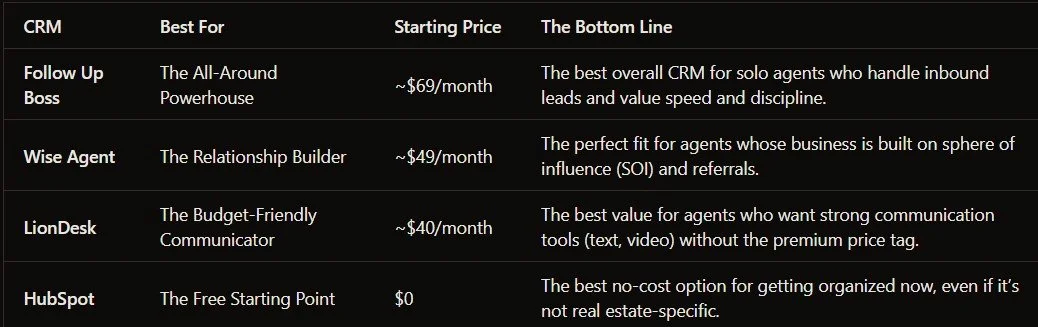
Top 4 CRM’s for Real Estate Agents - Starting Price + The Bottom Line
1. Follow Up Boss: The Best Overall for Solo Agents
You should choose Follow Up Boss if: Your business relies on converting inbound leads from multiple sources (Zillow, your website, social media) and you know that speed-to-lead is everything.
Follow Up Boss is the undisputed king of lead management and disciplined follow-up. It’s less of a CRM and more of a command center. It pulls in leads from over 250 sources, tells you exactly who to call next with its Smart Lists, and keeps every text, call, and email in a clean, chronological timeline for each contact.
It’s not the cheapest, and it doesn’t come with a website. But if you’re serious about turning your leads into closings, the investment pays for itself. The “Grow” plan is the perfect starting point for a solo agent.
Pro: Unbeatable lead aggregation and speed-to-lead tools.
Con: The built-in dialer is an extra $39/month on the solo plan.
Bottom Line: If you’re paying for leads, you can’t afford not to have a system this tight.
2. Wise Agent: The Best for Relationship-Based Businesses
You should choose Wise Agent if: Your business is built on your sphere of influence (SOI), past clients, and referrals. You need a system that helps you nurture relationships, not just chase new leads.
Wise Agent gets that for many agents, the money is in the long-term relationship, not the instant conversion. It’s packed with marketing tools designed for nurturing: monthly newsletters, landing pages, and robust transaction management checklists. It’s an all-in-one platform that feels like it was actually built by agents.
It may not feel as sleek or aggressive as Follow Up Boss for rapid-fire lead response, but its strength is in its consistency. It’s the steady, reliable engine for the agent who wins on trust, not just speed.
Pro: Excellent marketing and transaction management tools included at a great price.
Con: The interface can feel a bit dated compared to newer platforms.
Bottom Line: If your motto is “relationships over transactions,” Wise Agent speaks your language.
3. LionDesk: The Best Value for Communication Power
You should choose LionDesk if: You want to leverage text and video in your follow-up but don’t want to pay a premium for it. You value personal communication and need a tool that makes it easy and affordable.
LionDesk’s core strength is its communication suite. It was one of the first CRMs to integrate video messaging directly into its platform, and its bulk texting and drip campaigns are powerful for the price. It’s a workhorse CRM that gives you the tools to connect with your database in a more personal way.
It’s not as polished as the top-tier players, and its analytics are basic. But for a solo agent who wants to stand out by being more human in their follow-up, LionDesk offers incredible value.
Pro: Includes video email, bulk texting, and AI-powered lead follow-up at a very competitive price.
Con: The user experience isn’t as intuitive as Follow Up Boss or Wise Agent.
Bottom Line: The best bang-for-your-buck if your strategy is built on personal outreach.
4. HubSpot: The Best Free Starting Point
You should choose HubSpot if: Your budget is zero and you need to get your contacts out of a spreadsheet and into a real system today.
Let’s be clear: HubSpot is not a real estate CRM. But its free version is a powerful, clean, and reliable platform for basic contact and deal management. You can create a pipeline, track your deals, and log your activities. It’s a massive step up from having no system at all.
The downside is that you’ll spend time customizing it to make sense for real estate. You’ll have to manually create properties for “Listings” and “Closings,” and you won’t get any of the industry-specific automations that make paid CRMs so valuable. But as a starting line, it’s unbeatable.
Pro: It’s free, it’s easy to use, and it provides the fundamental structure every agent needs.
Con: Requires significant customization and lacks real estate-specific features.
Bottom Line: A smart, professional choice when you’re just starting out and need to build good habits without the monthly fee.
The Final Verdict
Your CRM is the engine of your business. Choosing the right one isn’t about finding the “best” one—it’s about finding the one that matches your business model, your budget, and your personality.
For the conversion-focused agent: Choose Follow Up Boss.
For the relationship-focused agent: Choose Wise Agent.
For the budget-conscious communicator: Choose LionDesk.
For the agent starting from scratch: Start with HubSpot.
Need help getting your CRM set up, your database cleaned, and your follow-up automated? That’s exactly what I do. Book a free consultation and let’s build a system that actually works for you.
Frequently Asked Questions
What is the best CRM for a solo real estate agent?
It depends on how you run your business. If you're converting inbound leads from Zillow, your website, or social media, Follow Up Boss is the strongest option for speed-to-lead and pipeline discipline. If your business runs on referrals and sphere of influence, Wise Agent is built for that relationship-first approach. There's no single "best" — there's the best fit for how you actually work.
How much should a solo agent spend on a CRM?
Most solo agents should budget between $25 and $75 per month. Wise Agent and LionDesk both come in around $40-$49/month and cover the essentials. Follow Up Boss starts at $58/month and is worth it if you're actively spending on lead generation. If your budget is truly zero, HubSpot's free tier gets you out of the spreadsheet and into a real system today.
Do I really need a CRM if I only close 10-15 deals a year?
Yes — arguably more than a high-volume agent. When every deal matters, you can't afford to let a lead slip through the cracks because you forgot to follow up. A CRM isn't about volume. It's about consistency. The agents closing 10-15 deals who use a CRM are the ones who grow to 20-25 without burning out.
Can I use HubSpot as a real estate CRM?
You can, but you'll need to customize it. HubSpot's free tier gives you contact management, deal pipelines, and activity logging — but none of it is real estate-specific out of the box. You'll manually create custom properties for things like listing addresses, closing dates, and transaction types. It works as a starting point, but most agents outgrow it within 6-12 months and move to a purpose-built platform.
What's the difference between a real estate CRM and a general CRM?
Real estate CRMs come pre-built with industry workflows: transaction management checklists, MLS integrations, drip campaigns timed to the buying cycle, and lead routing from sources like Zillow and Realtor.com. General CRMs like HubSpot or Salesforce require you to build all of that from scratch. For a solo agent, the time savings alone make a real estate-specific CRM worth the investment.
Should I pick a CRM based on features or price?
Neither — pick it based on fit. The most expensive CRM is the one you stop using after 60 days because it doesn't match how you work. If you're a relationship-driven agent, a lead-conversion machine like Follow Up Boss will feel overwhelming. If you're running paid ads and need speed, a nurture-focused tool like Wise Agent will feel too slow. Match the tool to your workflow first, then compare price within that category.
How long does it take to set up a real estate CRM?
Most solo agents can get up and running in 2-4 hours. That includes importing your contacts, setting up your pipeline stages, and creating your first drip campaign or follow-up sequence. Wise Agent and Follow Up Boss both offer onboarding support. The real investment isn't setup — it's the first 30 days of building the habit of actually using it every day.
Can I switch CRMs without losing my contacts?
Yes. Every CRM on this list supports CSV export and import, so your contact data is portable. The things you'll lose are your automation sequences, email templates, and activity history — which is why it's worth choosing carefully upfront. If you're switching, export everything, clean your data, and treat it as a fresh start rather than a copy-paste migration.