

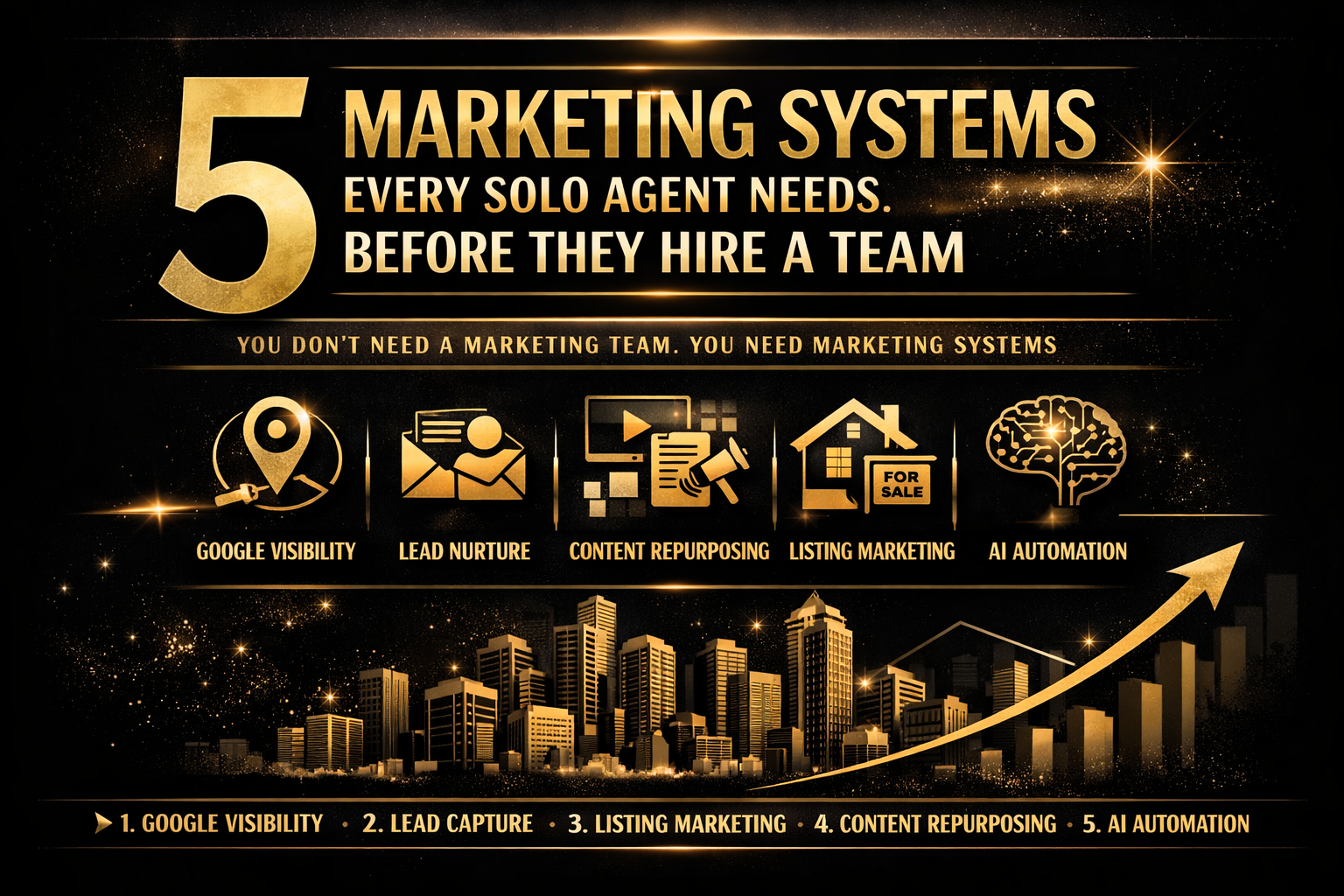
5 Marketing Systems Every Solo Agent Needs Before They Hire a Team
Five Marketing Systems every solo agent needs before they hire a team. You don’t need a marketing team, you need a marketing system.
Let me save you a very expensive mistake.
You're a solo agent doing $3M-$8M in volume. You're busy. You're closing deals. And somewhere between your 47th showing and your 12th "just checking in" text, you think: I need to hire someone to handle my marketing.
So you hire a social media manager. Or a VA. Or a "marketing assistant" who's really just your nephew's girlfriend who knows how to use Canva.
And three months later, you've spent $3,000-$6,000 and your marketing looks exactly the same — or worse, it looks like someone else's brand wearing your name tag.
Here's what nobody tells you: you don't need a team. You need systems. And until you have the right systems in place, adding people just adds chaos.
I've worked with dozens of agents across Raleigh and Lake Norman, and the pattern is always the same. The agents who scale smoothly aren't the ones who hired first — they're the ones who systematized first. Here are the five marketing systems every solo agent needs locked in before they even think about bringing on help.
System 1: Your Google Visibility System
If you don't have a system for showing up on Google, nothing else matters. Not your Instagram. Not your email list. Not your fancy new headshots.
Google is where intent lives. When someone searches "homes for sale in North Hills Raleigh" or "best listing agent Lake Norman," they're not browsing — they're buying. And if you're not in the top three results (or the Map Pack), you're invisible to the highest-intent leads in your market.
Your Google Visibility System includes three components. First, a fully optimized Google Business Profile that gets updated weekly — not set up once and forgotten. Second, a website with dedicated pages for every neighborhood and service area you work, each targeting specific local keywords. Third, a review generation process that consistently brings in fresh five-star reviews with keyword-rich content.
This system should run on autopilot once it's built. You spend 30 minutes a week posting to your GBP and responding to reviews. Your website pages work 24/7 in the background. And your review process triggers automatically after every closing.
Most agents skip this system entirely because it's not "sexy." It doesn't get likes. It doesn't go viral. But it generates more consistent, high-quality leads than any social media strategy ever will.
System 2: Your Lead Capture and Nurture System
Here's a question that makes most solo agents uncomfortable: what happens when someone visits your website?
If the answer is "nothing" — if there's no lead magnet, no email capture, no follow-up sequence — then you're paying for traffic (whether through SEO, ads, or social) and letting it walk right out the door.
Your Lead Capture and Nurture System has two parts.
The capture is a valuable piece of content that someone will trade their email for. This could be a neighborhood guide, a home seller's checklist, a market report, or a "What's My Home Worth" tool. The key is that it has to be genuinely useful — not a thinly veiled sales pitch disguised as a PDF.
The nurture is an automated email sequence that delivers value over time and positions you as the obvious choice when they're ready to buy or sell. This isn't a drip campaign that sends "just checking in!" every two weeks. It's a strategic sequence that educates, builds trust, and makes a clear case for why you're different.
A basic nurture sequence looks like this: an immediate delivery email with the resource they requested, followed by a value email two days later sharing a market insight or tip, then a story email on day five featuring a recent client success, a positioning email on day eight explaining what makes your approach different, and finally a soft CTA on day twelve inviting them to book a call or reply with questions.
Five emails. Automated. Running in the background while you're at showings. This is the system that turns website visitors into actual conversations — and most solo agents don't have it.
System 3: Your Content Repurposing System
The biggest time trap in real estate marketing is creating content from scratch every single day. You don't need to do that. You need a repurposing system.
Here's how it works: you create one core piece of content per week. That's it. One blog post, one video, or one long-form social post. Then you break it into smaller pieces that feed every other channel.
One blog post becomes a LinkedIn article (copy-paste with minor edits), three to four social media posts pulling key quotes or stats, one email newsletter highlighting the main takeaway, one Google Business Profile post with a local angle, and one short-form video script if you're doing video.
That's six to seven pieces of content from one hour of writing. Without a repurposing system, you'd spend six to seven hours creating each piece individually — and most of them would be worse because you'd be rushing.
The system part is important. This isn't about being creative in the moment. It's about having a repeatable process: write the core piece on Monday, break it down on Tuesday, schedule everything on Wednesday. Same rhythm every week. Same process. Same result.
When you eventually hire someone to help with marketing, this system is what you hand them. Without it, you're asking them to figure out your voice, your strategy, and your workflow from scratch. With it, you're handing them a machine that just needs someone to press the buttons.
System 4: Your Listing Marketing System
Every listing is a marketing event. Not just for the seller — for you.
Most agents treat listing marketing as a checklist: take photos, write a description, put it on MLS, post it on social media, done. But the agents who build their brand through listings treat every single one as a campaign.
Your Listing Marketing System should include a pre-listing package that wows the seller before you even get the contract (this is also your listing presentation differentiator), a professional photography and staging coordination process, a property-specific landing page or single-property website, a social media launch sequence (coming soon, just listed, open house, price update, under contract, just sold), an email blast to your database with the new listing, a neighborhood door-knock or direct mail piece, and a post-sale case study that you add to your website.
The key word here is "system." Every listing goes through the same process. You're not reinventing the wheel each time. You have templates, timelines, and checklists that make every listing look like a luxury launch — even if it's a $250K starter home.
This system does double duty: it impresses your sellers (which leads to referrals) and it builds your brand in the market (which leads to more listings). It's the single highest-ROI marketing system a solo agent can build.
System 5: Your AI Implementation System
This is the one that separates 2026 agents from 2020 agents.
AI isn't replacing real estate agents. But agents who use AI are replacing agents who don't. And the difference isn't about using ChatGPT to write a listing description — it's about building AI into your daily workflow so you operate at twice the speed with half the effort.
Your AI Implementation System covers four areas.
Content creation means using AI to draft blog posts, social captions, email sequences, and listing descriptions — then editing them in your voice. This cuts content creation time by 60-70%.
Client communication involves AI-powered templates for follow-ups, check-ins, and market updates that feel personal but take seconds to customize. You're not writing every email from scratch anymore.
Market research is about using AI to analyze market data, pull comparable sales, generate neighborhood insights, and create market reports in minutes instead of hours.
Lead qualification means AI chatbots or automated response systems that engage website visitors, answer common questions, and route serious inquiries to you — so you're not spending time on tire-kickers.
The agents I work with who implement even two of these four areas consistently report saving 10-20 hours per month. That's 10-20 hours you can spend on dollar-productive activities — or, you know, actually having a life.
The system part matters here too. It's not about using AI randomly when you remember. It's about building AI into your standard operating procedures so it becomes automatic. Your Monday content creation session uses AI. Your Friday follow-up batch uses AI templates. Your monthly market report is AI-assisted. Same process, every time.
The Order Matters
If you're reading this and thinking "I need all five," you're right. But don't try to build them all at once. That's how you burn out and end up with five half-built systems that don't work.
Here's the order I recommend:
Start with System 1 (Google Visibility). This is your foundation. It takes 2-3 weeks to fully build and starts generating leads almost immediately. Everything else builds on top of this.
Then build System 2 (Lead Capture and Nurture). Once you're getting traffic from Google, you need somewhere for those leads to go. This takes about a week to set up and runs on autopilot after that.
Next, add System 4 (Listing Marketing). Your next listing is your next opportunity to build this system. Create the templates and checklists once, then refine them with each listing.
Then layer in System 3 (Content Repurposing). Once you have your Google pages and your nurture sequence, you need a steady stream of content to feed them. The repurposing system makes this sustainable.
Finally, implement System 5 (AI). This is the accelerator. Once your other systems are in place, AI makes everything faster and better. But AI without systems is just faster chaos.
When You're Ready to Hire
Once all five systems are running, hiring becomes easy. You're not asking someone to "do your marketing." You're handing them documented systems with clear processes, templates, and expectations.
Your first hire should be someone who can run Systems 3 and 4 — content repurposing and listing marketing. These are the most time-intensive and the easiest to delegate because the creative decisions are already made. The hire just needs to execute the system.
Your Google Visibility and Lead Nurture systems should stay under your control (or be managed by a specialist) because they're too important to hand to a generalist.
And your AI system? That's yours. It's your competitive edge. Learn it, own it, and use it to stay two steps ahead of every other agent in your market.
The Bottom Line
You don't need a marketing team. You need marketing systems. Build the five systems outlined above, and you'll have a marketing operation that runs with minimal daily effort, generates consistent leads, and scales with your business.
Then — and only then — hire someone to help you run it.
The agents who build systems first and hire second always outperform the ones who do it the other way around. Always.
Emily Wyatt is the Founder of Real Estate Concierge Services Company LLC. She builds marketing systems for real estate agents and brokerages across Raleigh and Lake Norman — so they can stop guessing and start getting found.
Not sure which system to build first? Take the free Marketing Scorecard [blocked] to see where your biggest gaps are, or book a strategy call and we'll map it out together.
Part of The Agent Edge series:

Why Raleigh Real Estate Agents Are Losing Leads to AI (And How to Fix It)
Your potential clients are asking AI for agent recommendations instead of Googling you. And when they do, your name probably doesn't come up. Here's why Raleigh is ground zero for the AI lead shift — and the 5 fixes that actually work.
Something shifted in Raleigh's real estate market this year, and most agents haven't noticed yet.
It's not interest rates. It's not inventory. It's not even the influx of out-of-state buyers (although that's still very real). It's something quieter, more fundamental, and far more disruptive.
Your potential clients are asking AI for recommendations instead of Googling you.
And when they ask ChatGPT "Who's the best listing agent in North Raleigh?" or tell Perplexity "Find me a real estate agent in Lake Norman who specializes in relocation" — your name probably doesn't come up.
Not because you're not good. Not because you don't have the reviews or the track record. But because AI doesn't know you exist.
That's the lead leak nobody's talking about. And in a market like Raleigh — where competition is fierce, transplants are flooding in from the Northeast and West Coast, and tech-savvy buyers are the norm — it's costing agents real money right now.
The Shift Nobody Saw Coming
For 20 years, the real estate lead generation playbook was simple: rank on Google, run some ads, post on social media, and work your sphere. If you showed up on page one of Google or in the Map Pack, you won.
That playbook still works — but it's no longer enough.
Here's what's changed. According to recent data, over 40% of consumers under 45 now use AI tools as their first step when researching a major purchase or service. Not Google. Not Yelp. Not Instagram. They open ChatGPT or Perplexity and ask a question in plain English.
"Who should I hire to sell my house in Cary?"
"What's the best neighborhood in Raleigh for families relocating from New York?"
"Find me a real estate agent in Mooresville who does good marketing."
These are real queries. Real people. Real leads. And the AI is answering them — with or without you.
How AI Decides Who to Recommend
Here's the part that matters: AI doesn't recommend agents the same way Google ranks websites. Google uses backlinks, keywords, and technical signals. AI uses something different — and understanding this difference is the key to getting found.
Large language models like ChatGPT, Gemini, and Perplexity build their answers from a combination of sources. They look at entity recognition, meaning how clearly and consistently you're defined as a real estate professional across the internet. They evaluate citation frequency, which is how often your name appears in authoritative contexts (articles, directories, interviews, press mentions). They assess content relevance, meaning whether you've published content that directly answers the question being asked. And they consider structured data, which refers to schema markup and metadata that helps AI understand who you are, where you work, and what you specialize in.
If you've never thought about any of these things, you're not alone. Most agents haven't. But the ones who have? They're showing up in AI answers while their competitors wonder where the leads went.
A Real Example from Raleigh
I ran an AI citation audit for an agent in the Triangle earlier this year. She's been in the business for 12 years. Great reviews. Strong Google presence. Solid social media following. By every traditional metric, she was doing everything right.
I tested ten AI queries related to real estate in her market:
"Best real estate agent in Raleigh NC"
"Top listing agent in North Raleigh"
"Real estate agent for relocating to Cary"
"Who should I hire to sell my home in Wake Forest"
And six more variations covering her service areas and specialties.
She appeared in zero out of ten answers. Zero.
Not because she's bad at her job - she's excellent. But because she had almost no AI-readable signals. Her website had no schema markup. She had no long-form content answering these specific questions. Her name appeared on Zillow and Realtor.com, but not on any high-authority local sites. And her Google Business Profile, while decent, wasn't structured in a way that AI could easily parse.
We spent eight weeks implementing what I call the AI Visibility Stack - a three-layer system that addresses Google visibility, AI citation authority, and content strategy simultaneously. After eight weeks, she was appearing in six out of eight AI-generated answers for her target queries.
Her phone started ringing with leads who said things like "ChatGPT recommended you" and "I asked Perplexity for the best agent in Raleigh and your name came up." These are leads she never would have gotten through traditional marketing alone.
Why Raleigh Is Ground Zero for This Shift
This isn't just a national trend — Raleigh is uniquely positioned as ground zero for the AI lead shift, and here's why.
The relocation factor. Raleigh has been one of the top relocation destinations in the country for five years running. People moving from out of state don't have a local network to ask for agent referrals. They're Googling. They're asking AI. They're relying on technology to find someone they can trust. If you're not showing up in those AI answers, you're losing relocation leads to agents who are.
The tech-savvy buyer. The Triangle is a tech hub. Research Triangle Park, the universities, the startup ecosystem — this market is full of buyers and sellers who are early adopters of AI tools. They're not just using ChatGPT for fun. They're using it for real decisions, including who to hire as their real estate agent.
The competition density. There are over 10,000 licensed real estate agents in the Triangle. In a market that crowded, traditional differentiation (nice headshots, a catchy tagline, a Zillow Premier Agent subscription) isn't enough anymore. AI visibility is the new differentiator — and right now, almost nobody in Raleigh is optimizing for it.
The Lake Norman expansion. As Raleigh's influence extends toward Charlotte and the Lake Norman corridor, agents serving both markets have an even bigger opportunity. The agents who establish AI visibility across both the Triangle and Lake Norman will dominate a massive geographic footprint.
The 5 Fixes That Actually Work
If you're a Raleigh agent reading this and thinking "I need to fix this yesterday," here's your action plan. These are the five highest-impact moves you can make, in order of priority.
Fix 1: Add Schema Markup to Your Website
This is the single fastest win. Schema markup is structured data that tells search engines and AI exactly who you are, what you do, and where you do it. Most real estate websites have zero schema markup — which means AI has to guess what your site is about.
Add LocalBusiness schema with your name, brokerage, address, phone, and service areas. Add Person schema for your agent profile. Add FAQ schema to your most important pages. And add Review schema to display your ratings in a machine-readable format.
This can be done in an afternoon, and it immediately makes your website more visible to AI models.
Fix 2: Create Question-Answering Content
AI answers questions. So create content that answers the exact questions people are asking.
Use tools like AnswerThePublic, AlsoAsked, or even ChatGPT itself to find the questions people ask about real estate in Raleigh, Cary, Apex, Wake Forest, Holly Springs, Mooresville, and every other market you serve.
Then write blog posts that answer those questions directly, thoroughly, and better than anyone else. Not 200-word fluff pieces — real, substantive, 1,500+ word articles that establish you as the authority on that topic.
"What's it like to live in North Hills Raleigh?" "How much does it cost to sell a house in Cary in 2026?" "Best neighborhoods in Lake Norman for families." These are the queries AI is answering right now. Make sure your content is what it pulls from.
Fix 3: Get Cited on Authority Sites
AI models weight mentions on high-authority websites more heavily than mentions on low-authority sites. Getting quoted in a local news article is worth more than 50 social media posts in terms of AI visibility.
Pitch yourself as a source to local media outlets like the News & Observer, Triangle Business Journal, and Charlotte Observer. Write guest posts for industry publications. Get listed on your local chamber of commerce website. Contribute to neighborhood guides on community sites.
Every authoritative mention of your name + your specialty + your location is a signal that AI models use when deciding who to recommend.
Fix 4: Optimize Your Google Business Profile for AI
Your GBP isn't just for Google Search anymore — AI models also pull from Google's data. Make sure your profile is complete (every field filled), active (posting weekly), and keyword-rich (your posts and descriptions should include your service areas and specialties naturally).
Pay special attention to your Q&A section. Add questions and answers that mirror the queries people are asking AI. "Do you work with relocation buyers?" "What areas do you serve?" "What's your marketing strategy for listings?" These Q&As become training data for AI models.
Fix 5: Build a Consistent Content Engine
AI favors recency. A website that hasn't been updated in months sends a signal that you might not be active or relevant. A website that publishes fresh, locally-targeted content every week sends the opposite signal.
You don't need to publish every day. But you do need a rhythm: one blog post every two weeks, one GBP post every week, and one long-form piece every month. That's enough to keep both Google and AI models seeing you as an active, authoritative source in your market.
The Window Is Open — But Not for Long
Here's the thing about AI visibility: it's still early. Most agents — even in a tech-savvy market like Raleigh — haven't started optimizing for it. That means the window to establish yourself as the AI-recommended agent in your market is wide open.
But it won't stay open forever. As more agents (and more marketing companies) catch on, the competition for AI citations will intensify. The agents who build their AI visibility now will have a compounding advantage that's extremely difficult to overcome later.
Think about it like Google SEO in 2010. The agents who started optimizing early dominated their markets for a decade. The ones who waited until 2015 or 2018 had to fight ten times harder for the same results.
AI visibility in 2026 is where Google SEO was in 2010. The opportunity is massive, the competition is low, and the agents who move first will win.
What to Do Right Now
If you're a Raleigh or Lake Norman agent and you want to know exactly where you stand, start with an AI citation audit. Ask ChatGPT, Perplexity, and Gemini the ten most common queries about real estate in your market. See if your name comes up. If it doesn't, you know exactly what you need to fix.
Then start with the five fixes above. Schema markup first (it's the quickest win), then content creation, then authority building. Give it eight weeks of consistent effort and audit again. You'll be amazed at the difference.
The leads are out there. The clients are asking. The only question is whether AI knows your name.
Make sure it does.
Emily Wyatt is the Founder of Real Estate Concierge Services Company LLC, helping real estate agents across Raleigh and Lake Norman build visibility systems that get them found — by Google, by AI, and by the clients who are already searching. Based in the Triangle and serving agents across North Carolina.
Want to see where you stand? Book a strategy call](https://calendly.com/ejwyatt-realtor-concierge-services/30min) and let's build your AI Visibility Stack together.
Part of The Agent Edge series:
The AI Visibility Stack: How Smart Agents Are Getting Found in 2026
5 Marketing Systems Every Solo Agent Needs Before They Hire a Team
Best Real Estate CRMs for Solo Agents (2026 Comparison)
2026 CRM Comparison Guide for Realtors
Let’s be honest: as a solo real estate agent, your CRM isn’t just a digital address book. It’s your business partner, your second brain, and the only thing standing between you and a pipeline full of missed opportunities. But the market is flooded with options, most of them built for massive teams with budgets to match.
So, which CRM is actually the right fit for a solo agent in 2026? It’s not the one with the most features. It’s the one you’ll actually use.
After reviewing dozens of platforms and talking to agents on the ground, I’ve narrowed it down to the only options that matter for solo agents. Here’s the no-fluff breakdown.
The Only 4 CRMs You Should Be Considering
Forget the endless lists. For 99% of solo agents, the right choice is one of these four, each for a very different reason. Make it stand out. Whatever it is, the way you tell your story online can make all the difference.
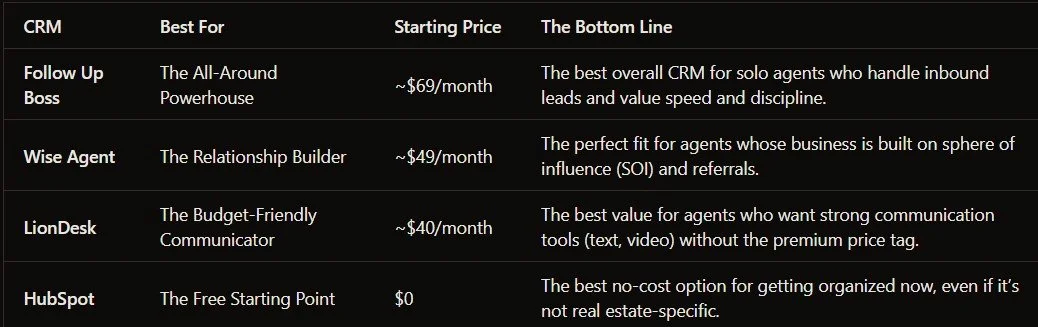
Top 4 CRM’s for Real Estate Agents - Starting Price + The Bottom Line
1. Follow Up Boss: The Best Overall for Solo Agents
You should choose Follow Up Boss if: Your business relies on converting inbound leads from multiple sources (Zillow, your website, social media) and you know that speed-to-lead is everything.
Follow Up Boss is the undisputed king of lead management and disciplined follow-up. It’s less of a CRM and more of a command center. It pulls in leads from over 250 sources, tells you exactly who to call next with its Smart Lists, and keeps every text, call, and email in a clean, chronological timeline for each contact.
It’s not the cheapest, and it doesn’t come with a website. But if you’re serious about turning your leads into closings, the investment pays for itself. The “Grow” plan is the perfect starting point for a solo agent.
Pro: Unbeatable lead aggregation and speed-to-lead tools.
Con: The built-in dialer is an extra $39/month on the solo plan.
Bottom Line: If you’re paying for leads, you can’t afford not to have a system this tight.
2. Wise Agent: The Best for Relationship-Based Businesses
You should choose Wise Agent if: Your business is built on your sphere of influence (SOI), past clients, and referrals. You need a system that helps you nurture relationships, not just chase new leads.
Wise Agent gets that for many agents, the money is in the long-term relationship, not the instant conversion. It’s packed with marketing tools designed for nurturing: monthly newsletters, landing pages, and robust transaction management checklists. It’s an all-in-one platform that feels like it was actually built by agents.
It may not feel as sleek or aggressive as Follow Up Boss for rapid-fire lead response, but its strength is in its consistency. It’s the steady, reliable engine for the agent who wins on trust, not just speed.
Pro: Excellent marketing and transaction management tools included at a great price.
Con: The interface can feel a bit dated compared to newer platforms.
Bottom Line: If your motto is “relationships over transactions,” Wise Agent speaks your language.
3. LionDesk: The Best Value for Communication Power
You should choose LionDesk if: You want to leverage text and video in your follow-up but don’t want to pay a premium for it. You value personal communication and need a tool that makes it easy and affordable.
LionDesk’s core strength is its communication suite. It was one of the first CRMs to integrate video messaging directly into its platform, and its bulk texting and drip campaigns are powerful for the price. It’s a workhorse CRM that gives you the tools to connect with your database in a more personal way.
It’s not as polished as the top-tier players, and its analytics are basic. But for a solo agent who wants to stand out by being more human in their follow-up, LionDesk offers incredible value.
Pro: Includes video email, bulk texting, and AI-powered lead follow-up at a very competitive price.
Con: The user experience isn’t as intuitive as Follow Up Boss or Wise Agent.
Bottom Line: The best bang-for-your-buck if your strategy is built on personal outreach.
4. HubSpot: The Best Free Starting Point
You should choose HubSpot if: Your budget is zero and you need to get your contacts out of a spreadsheet and into a real system today.
Let’s be clear: HubSpot is not a real estate CRM. But its free version is a powerful, clean, and reliable platform for basic contact and deal management. You can create a pipeline, track your deals, and log your activities. It’s a massive step up from having no system at all.
The downside is that you’ll spend time customizing it to make sense for real estate. You’ll have to manually create properties for “Listings” and “Closings,” and you won’t get any of the industry-specific automations that make paid CRMs so valuable. But as a starting line, it’s unbeatable.
Pro: It’s free, it’s easy to use, and it provides the fundamental structure every agent needs.
Con: Requires significant customization and lacks real estate-specific features.
Bottom Line: A smart, professional choice when you’re just starting out and need to build good habits without the monthly fee.
The Final Verdict
Your CRM is the engine of your business. Choosing the right one isn’t about finding the “best” one—it’s about finding the one that matches your business model, your budget, and your personality.
For the conversion-focused agent: Choose Follow Up Boss.
For the relationship-focused agent: Choose Wise Agent.
For the budget-conscious communicator: Choose LionDesk.
For the agent starting from scratch: Start with HubSpot.
Need help getting your CRM set up, your database cleaned, and your follow-up automated? That’s exactly what I do. Book a free consultation and let’s build a system that actually works for you.
Frequently Asked Questions
What is the best CRM for a solo real estate agent?
It depends on how you run your business. If you're converting inbound leads from Zillow, your website, or social media, Follow Up Boss is the strongest option for speed-to-lead and pipeline discipline. If your business runs on referrals and sphere of influence, Wise Agent is built for that relationship-first approach. There's no single "best" — there's the best fit for how you actually work.
How much should a solo agent spend on a CRM?
Most solo agents should budget between $25 and $75 per month. Wise Agent and LionDesk both come in around $40-$49/month and cover the essentials. Follow Up Boss starts at $58/month and is worth it if you're actively spending on lead generation. If your budget is truly zero, HubSpot's free tier gets you out of the spreadsheet and into a real system today.
Do I really need a CRM if I only close 10-15 deals a year?
Yes — arguably more than a high-volume agent. When every deal matters, you can't afford to let a lead slip through the cracks because you forgot to follow up. A CRM isn't about volume. It's about consistency. The agents closing 10-15 deals who use a CRM are the ones who grow to 20-25 without burning out.
Can I use HubSpot as a real estate CRM?
You can, but you'll need to customize it. HubSpot's free tier gives you contact management, deal pipelines, and activity logging — but none of it is real estate-specific out of the box. You'll manually create custom properties for things like listing addresses, closing dates, and transaction types. It works as a starting point, but most agents outgrow it within 6-12 months and move to a purpose-built platform.
What's the difference between a real estate CRM and a general CRM?
Real estate CRMs come pre-built with industry workflows: transaction management checklists, MLS integrations, drip campaigns timed to the buying cycle, and lead routing from sources like Zillow and Realtor.com. General CRMs like HubSpot or Salesforce require you to build all of that from scratch. For a solo agent, the time savings alone make a real estate-specific CRM worth the investment.
Should I pick a CRM based on features or price?
Neither — pick it based on fit. The most expensive CRM is the one you stop using after 60 days because it doesn't match how you work. If you're a relationship-driven agent, a lead-conversion machine like Follow Up Boss will feel overwhelming. If you're running paid ads and need speed, a nurture-focused tool like Wise Agent will feel too slow. Match the tool to your workflow first, then compare price within that category.
How long does it take to set up a real estate CRM?
Most solo agents can get up and running in 2-4 hours. That includes importing your contacts, setting up your pipeline stages, and creating your first drip campaign or follow-up sequence. Wise Agent and Follow Up Boss both offer onboarding support. The real investment isn't setup — it's the first 30 days of building the habit of actually using it every day.
Can I switch CRMs without losing my contacts?
Yes. Every CRM on this list supports CSV export and import, so your contact data is portable. The things you'll lose are your automation sequences, email templates, and activity history — which is why it's worth choosing carefully upfront. If you're switching, export everything, clean your data, and treat it as a fresh start rather than a copy-paste migration.
The Realtor’s Catch‑22: You Need Marketing to Sell Homes, but You Need Sales to Afford Marketing — Here’s How to Break the Cycle
Stuck in the marketing catch‑22? You need marketing to sell homes but sales to fund your marketing. Discover how to break the cycle with smart strategies, AI tools, and bold storytelling.

Catch 22 graphic depicting the struggle for agents needing marketing to get listings but needing listings to afford marketing
If you’ve ever felt trapped by the paradox of needing marketing to get listings and needing listings to pay for marketing, you’re not alone. A recent LinkedIn post showed that 86 % of agents stay with a brokerage because of the marketing support they receive — yet most feel abandoned when it comes to actual strategy. That gap is exactly why so many realtors are stuck in neutral.
Why traditional marketing falls short
Too many agents throw money at generic ads and lead‑generation services that promise the moon and deliver dusty email lists. Marketing consultant Carter Vincentini didn’t mince words when he said “95 % of real estate marketing is trash”. Leads like “I love this area and want to serve you” rarely convert because they lack specificity and authenticity. Without a clear brand story and strategic messaging, your posts are just more noise.
The data confirms the shift
New survey research from The Real Brokerage found that 88 % of agents are already using AI to enhance marketing assets, property descriptions, social media posts and virtual stagings. Even more telling, 68 % of agents say AI saves them significant time, and 14 % credit AI tools with improving marketing effectivenesss. The message: automation isn’t an option any more — it’s the foundation. The remaining gap is strategy and storytelling.
Break out of the marketing catch‑22
Here’s how to reclaim control of your pipeline without burning cash:
Lead with value, not vanity. Instead of boilerplate posts, share insights specific to your market: neighborhood changes, upcoming zoning decisions, or how national interest‑rate shifts affect local buyers. Demonstrate that you know more than the MLS; you understand how homes fit into people’s lives.
Adopt AI — but make it personal. Use AI tools (like ChatGPT) to draft property descriptions, video scripts and email sequences, but always inject your authentic voice. AI saves time; your human touch seals the deal.
Invest in content that compounds. Stop throwing money at single‑use ads. Build evergreen guides, checklists and explainer videos that answer common questions (“How do I time the market?” or “What does a pre‑inspection really save me?”). These assets position you as a trusted advisor and can be repurposed across Instagram, TikTok, LinkedIn and email.
Join the conversation where it’s happening. Facebook groups like Real Estate Agent Referral Network & Marketing Tips have hundreds of thousands of members seeking advice. Show up. Answer questions. Share your insights without pitching. When agents see you as a resource, you become their go‑to when they’re finally ready for professional support.
Build strategic partnerships. Align with local businesses, mortgage brokers and home‑service providers. Co‑host webinars or Instagram Lives that tackle topics your audience cares about (e.g., staging on a budget, understanding appraisal gaps). Combined audiences multiply exposure without multiplying costs.
Final take
Marketing isn’t a cost centre; it’s an investment. The real catch‑22 isn’t a lack of budget, it’s a lack of strategy. When you master authentic storytelling, adopt smart tools and show up consistently, your marketing not only pays for itself — it becomes your unfair advantage.
Ready to stop wasting money on ads that don’t convert? Let’s design a marketing strategy that actually works — and break your business out of its vicious cycle.