


Why Raleigh Real Estate Agents Are Losing Leads to AI (And How to Fix It)
Your potential clients are asking AI for agent recommendations instead of Googling you. And when they do, your name probably doesn't come up. Here's why Raleigh is ground zero for the AI lead shift — and the 5 fixes that actually work.
Something shifted in Raleigh's real estate market this year, and most agents haven't noticed yet.
It's not interest rates. It's not inventory. It's not even the influx of out-of-state buyers (although that's still very real). It's something quieter, more fundamental, and far more disruptive.
Your potential clients are asking AI for recommendations instead of Googling you.
And when they ask ChatGPT "Who's the best listing agent in North Raleigh?" or tell Perplexity "Find me a real estate agent in Lake Norman who specializes in relocation" — your name probably doesn't come up.
Not because you're not good. Not because you don't have the reviews or the track record. But because AI doesn't know you exist.
That's the lead leak nobody's talking about. And in a market like Raleigh — where competition is fierce, transplants are flooding in from the Northeast and West Coast, and tech-savvy buyers are the norm — it's costing agents real money right now.
The Shift Nobody Saw Coming
For 20 years, the real estate lead generation playbook was simple: rank on Google, run some ads, post on social media, and work your sphere. If you showed up on page one of Google or in the Map Pack, you won.
That playbook still works — but it's no longer enough.
Here's what's changed. According to recent data, over 40% of consumers under 45 now use AI tools as their first step when researching a major purchase or service. Not Google. Not Yelp. Not Instagram. They open ChatGPT or Perplexity and ask a question in plain English.
"Who should I hire to sell my house in Cary?"
"What's the best neighborhood in Raleigh for families relocating from New York?"
"Find me a real estate agent in Mooresville who does good marketing."
These are real queries. Real people. Real leads. And the AI is answering them — with or without you.
How AI Decides Who to Recommend
Here's the part that matters: AI doesn't recommend agents the same way Google ranks websites. Google uses backlinks, keywords, and technical signals. AI uses something different — and understanding this difference is the key to getting found.
Large language models like ChatGPT, Gemini, and Perplexity build their answers from a combination of sources. They look at entity recognition, meaning how clearly and consistently you're defined as a real estate professional across the internet. They evaluate citation frequency, which is how often your name appears in authoritative contexts (articles, directories, interviews, press mentions). They assess content relevance, meaning whether you've published content that directly answers the question being asked. And they consider structured data, which refers to schema markup and metadata that helps AI understand who you are, where you work, and what you specialize in.
If you've never thought about any of these things, you're not alone. Most agents haven't. But the ones who have? They're showing up in AI answers while their competitors wonder where the leads went.
A Real Example from Raleigh
I ran an AI citation audit for an agent in the Triangle earlier this year. She's been in the business for 12 years. Great reviews. Strong Google presence. Solid social media following. By every traditional metric, she was doing everything right.
I tested ten AI queries related to real estate in her market:
"Best real estate agent in Raleigh NC"
"Top listing agent in North Raleigh"
"Real estate agent for relocating to Cary"
"Who should I hire to sell my home in Wake Forest"
And six more variations covering her service areas and specialties.
She appeared in zero out of ten answers. Zero.
Not because she's bad at her job - she's excellent. But because she had almost no AI-readable signals. Her website had no schema markup. She had no long-form content answering these specific questions. Her name appeared on Zillow and Realtor.com, but not on any high-authority local sites. And her Google Business Profile, while decent, wasn't structured in a way that AI could easily parse.
We spent eight weeks implementing what I call the AI Visibility Stack - a three-layer system that addresses Google visibility, AI citation authority, and content strategy simultaneously. After eight weeks, she was appearing in six out of eight AI-generated answers for her target queries.
Her phone started ringing with leads who said things like "ChatGPT recommended you" and "I asked Perplexity for the best agent in Raleigh and your name came up." These are leads she never would have gotten through traditional marketing alone.
Why Raleigh Is Ground Zero for This Shift
This isn't just a national trend — Raleigh is uniquely positioned as ground zero for the AI lead shift, and here's why.
The relocation factor. Raleigh has been one of the top relocation destinations in the country for five years running. People moving from out of state don't have a local network to ask for agent referrals. They're Googling. They're asking AI. They're relying on technology to find someone they can trust. If you're not showing up in those AI answers, you're losing relocation leads to agents who are.
The tech-savvy buyer. The Triangle is a tech hub. Research Triangle Park, the universities, the startup ecosystem — this market is full of buyers and sellers who are early adopters of AI tools. They're not just using ChatGPT for fun. They're using it for real decisions, including who to hire as their real estate agent.
The competition density. There are over 10,000 licensed real estate agents in the Triangle. In a market that crowded, traditional differentiation (nice headshots, a catchy tagline, a Zillow Premier Agent subscription) isn't enough anymore. AI visibility is the new differentiator — and right now, almost nobody in Raleigh is optimizing for it.
The Lake Norman expansion. As Raleigh's influence extends toward Charlotte and the Lake Norman corridor, agents serving both markets have an even bigger opportunity. The agents who establish AI visibility across both the Triangle and Lake Norman will dominate a massive geographic footprint.
The 5 Fixes That Actually Work
If you're a Raleigh agent reading this and thinking "I need to fix this yesterday," here's your action plan. These are the five highest-impact moves you can make, in order of priority.
Fix 1: Add Schema Markup to Your Website
This is the single fastest win. Schema markup is structured data that tells search engines and AI exactly who you are, what you do, and where you do it. Most real estate websites have zero schema markup — which means AI has to guess what your site is about.
Add LocalBusiness schema with your name, brokerage, address, phone, and service areas. Add Person schema for your agent profile. Add FAQ schema to your most important pages. And add Review schema to display your ratings in a machine-readable format.
This can be done in an afternoon, and it immediately makes your website more visible to AI models.
Fix 2: Create Question-Answering Content
AI answers questions. So create content that answers the exact questions people are asking.
Use tools like AnswerThePublic, AlsoAsked, or even ChatGPT itself to find the questions people ask about real estate in Raleigh, Cary, Apex, Wake Forest, Holly Springs, Mooresville, and every other market you serve.
Then write blog posts that answer those questions directly, thoroughly, and better than anyone else. Not 200-word fluff pieces — real, substantive, 1,500+ word articles that establish you as the authority on that topic.
"What's it like to live in North Hills Raleigh?" "How much does it cost to sell a house in Cary in 2026?" "Best neighborhoods in Lake Norman for families." These are the queries AI is answering right now. Make sure your content is what it pulls from.
Fix 3: Get Cited on Authority Sites
AI models weight mentions on high-authority websites more heavily than mentions on low-authority sites. Getting quoted in a local news article is worth more than 50 social media posts in terms of AI visibility.
Pitch yourself as a source to local media outlets like the News & Observer, Triangle Business Journal, and Charlotte Observer. Write guest posts for industry publications. Get listed on your local chamber of commerce website. Contribute to neighborhood guides on community sites.
Every authoritative mention of your name + your specialty + your location is a signal that AI models use when deciding who to recommend.
Fix 4: Optimize Your Google Business Profile for AI
Your GBP isn't just for Google Search anymore — AI models also pull from Google's data. Make sure your profile is complete (every field filled), active (posting weekly), and keyword-rich (your posts and descriptions should include your service areas and specialties naturally).
Pay special attention to your Q&A section. Add questions and answers that mirror the queries people are asking AI. "Do you work with relocation buyers?" "What areas do you serve?" "What's your marketing strategy for listings?" These Q&As become training data for AI models.
Fix 5: Build a Consistent Content Engine
AI favors recency. A website that hasn't been updated in months sends a signal that you might not be active or relevant. A website that publishes fresh, locally-targeted content every week sends the opposite signal.
You don't need to publish every day. But you do need a rhythm: one blog post every two weeks, one GBP post every week, and one long-form piece every month. That's enough to keep both Google and AI models seeing you as an active, authoritative source in your market.
The Window Is Open — But Not for Long
Here's the thing about AI visibility: it's still early. Most agents — even in a tech-savvy market like Raleigh — haven't started optimizing for it. That means the window to establish yourself as the AI-recommended agent in your market is wide open.
But it won't stay open forever. As more agents (and more marketing companies) catch on, the competition for AI citations will intensify. The agents who build their AI visibility now will have a compounding advantage that's extremely difficult to overcome later.
Think about it like Google SEO in 2010. The agents who started optimizing early dominated their markets for a decade. The ones who waited until 2015 or 2018 had to fight ten times harder for the same results.
AI visibility in 2026 is where Google SEO was in 2010. The opportunity is massive, the competition is low, and the agents who move first will win.
What to Do Right Now
If you're a Raleigh or Lake Norman agent and you want to know exactly where you stand, start with an AI citation audit. Ask ChatGPT, Perplexity, and Gemini the ten most common queries about real estate in your market. See if your name comes up. If it doesn't, you know exactly what you need to fix.
Then start with the five fixes above. Schema markup first (it's the quickest win), then content creation, then authority building. Give it eight weeks of consistent effort and audit again. You'll be amazed at the difference.
The leads are out there. The clients are asking. The only question is whether AI knows your name.
Make sure it does.
Emily Wyatt is the Founder of Real Estate Concierge Services Company LLC, helping real estate agents across Raleigh and Lake Norman build visibility systems that get them found — by Google, by AI, and by the clients who are already searching. Based in the Triangle and serving agents across North Carolina.
Want to see where you stand? Book a strategy call](https://calendly.com/ejwyatt-realtor-concierge-services/30min) and let's build your AI Visibility Stack together.
Part of The Agent Edge series:
The AI Visibility Stack: How Smart Agents Are Getting Found in 2026
5 Marketing Systems Every Solo Agent Needs Before They Hire a Team
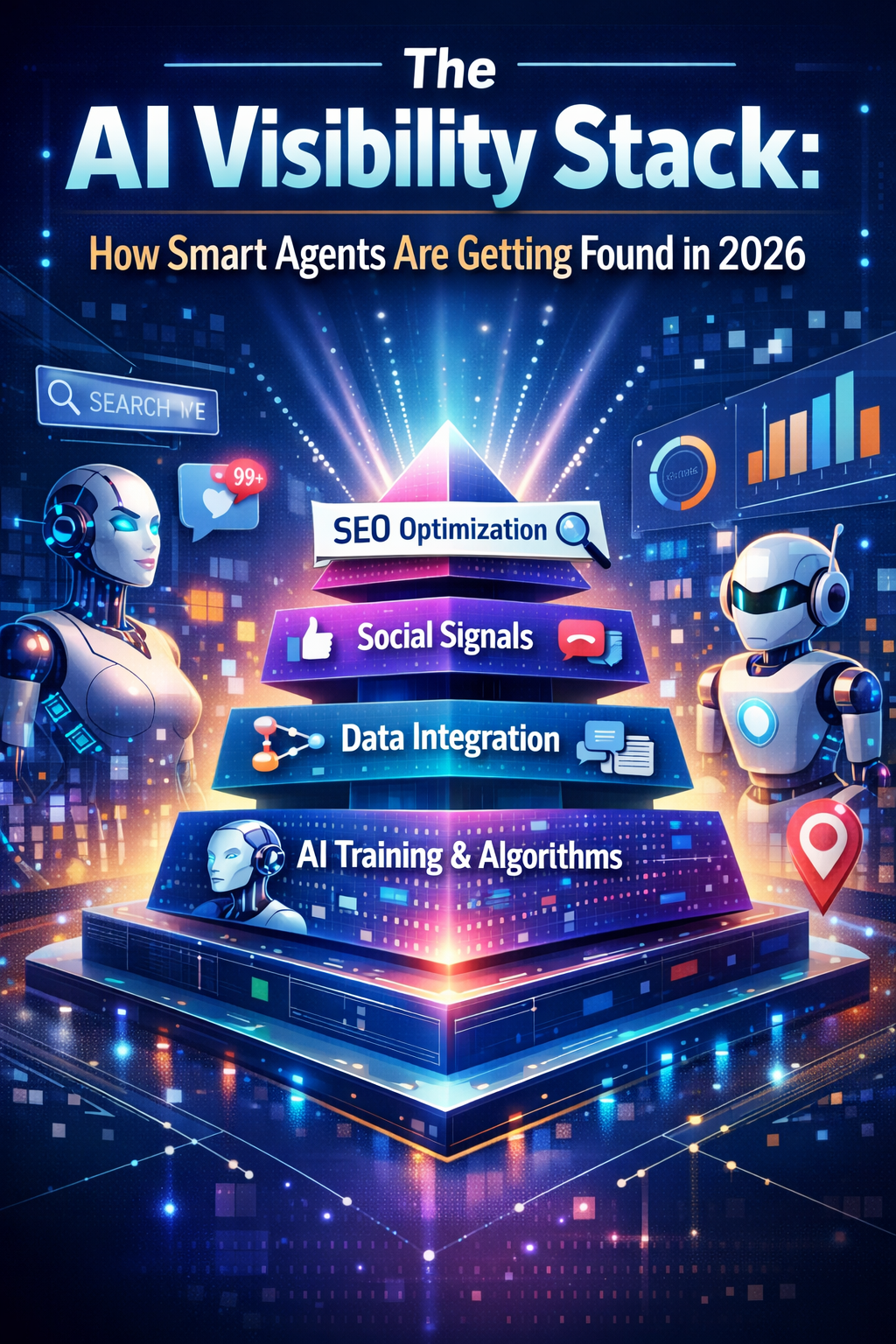
The AI Visibility Stack: How Smart Agents Are Getting Found in 2026
AI Invisibility stack - You can be the best agent in your market and still be invisible. In 2026, if you're not showing up in both traditional search AND AI-powered answers, you're leaving deals on the table. Here's the three-layer system smart agents are using to get found everywhere.
You can be the best agent in your market and still be invisible.
That's the uncomfortable truth most real estate professionals don't want to hear. You've got the closings, the client love, the five-star reviews — but when someone Googles "best real estate agent in Raleigh" or asks ChatGPT who to call about selling a home in Lake Norman, your name doesn't come up.
And in 2026, if you're not showing up in both traditional search AND AI-powered answers, you're leaving deals on the table every single week.
This is the year that visibility became a system — not a hope. And the agents who are winning right now? They're not just posting on Instagram and praying. They're running what I call The AI Visibility Stack.
What Is the AI Visibility Stack?
The AI Visibility Stack is a layered marketing system that ensures you show up everywhere your ideal client is looking — whether that's Google Search, Google Maps, ChatGPT, Perplexity, Gemini, or voice assistants like Siri and Alexa.
It's not one tactic. It's the combination of three interlocking systems that compound over time:
1. Google Visibility Foundation — Your Google Business Profile, local SEO, and website optimization working together so Google trusts you.
2. AI Citation Authority — Structured content and entity signals that make large language models (LLMs) reference you by name.
3. Content Engine — A consistent publishing rhythm that feeds both systems with fresh, relevant, locally-targeted content.
When all three layers are active, you don't just rank — you become the answer.
Layer 1: Google Visibility Foundation
This is where most agents start, but almost none finish. Having a Google Business Profile is table stakes. Optimizing it is where the money lives.
Here's what a fully optimized Google Visibility Foundation looks like:
Google Business Profile (GBP) optimization includes completing every single field (not just the basics), posting weekly updates with geo-tagged photos, responding to every review within 24 hours, adding services, products, and FAQs directly to your profile, and using Google Posts to highlight listings, open houses, and market updates.
Local SEO on your website means having dedicated neighborhood pages (not just one generic "areas I serve" page), schema markup that tells Google exactly who you are and where you operate, NAP consistency across every directory and citation source, and internal linking that connects your content to your service areas.
Technical health covers site speed under 3 seconds on mobile, mobile-first design (Google indexes mobile first), proper SSL, sitemap, and robots.txt configuration, and Core Web Vitals in the green zone.
Most agents have maybe 30% of this done. The ones showing up in the Map Pack and position one? They've done all of it.
Layer 2: AI Citation Authority
This is the new frontier, and it's where the biggest opportunity lives right now.
When someone asks ChatGPT "Who's the best real estate marketing company in Raleigh?" or "What agent should I use to sell my home in Mooresville?" — the AI pulls from a combination of sources to generate its answer. Those sources include high-authority websites and directories, structured data and entity signals, consistent mentions across the web (citations), content that directly answers the question being asked, and reviews and reputation signals.
The agents who show up in AI answers aren't gaming the system. They're building what I call entity authority — making themselves so clearly defined and consistently referenced across the internet that AI models can't ignore them.
Here's how to build AI Citation Authority:
Create entity-rich content. Write about yourself, your team, your market, and your specialties in a way that's structured and specific. Use your full name, brokerage, and location consistently. Include "About" schema on your website.
Get cited on authority sites. This means being mentioned (with links) on local news sites, industry publications, and high-domain-authority directories. Not just Zillow and Realtor.com — think local chambers of commerce, business journals, and community sites.
Answer the questions AI is asking. Look at what people are asking ChatGPT and Perplexity about real estate in your market. Then create content that directly answers those questions — on your website, your blog, and your Google Business Profile.
Publish structured data. FAQ schema, LocalBusiness schema, Person schema, and Review schema all help AI models understand who you are and what you do.
I recently ran an AI citation audit for an agent in Raleigh. Before we started, she appeared in zero out of ten AI-generated answers about real estate in her market. Eight weeks later, after implementing the AI Visibility Stack, she was cited in six out of eight queries. That's not magic — that's systems.
Layer 3: The Content Engine
The first two layers build your foundation. The Content Engine keeps it alive.
Here's the reality: Google and AI models both favor recency. A website that hasn't been updated in six months is a website that's losing ground. A Google Business Profile with no posts in 30 days is a profile that's slipping in rankings.
The Content Engine is a sustainable publishing rhythm that feeds both Google and AI with fresh signals. It doesn't have to be overwhelming. Here's what a realistic Content Engine looks like for a solo agent:
Weekly: One Google Business Profile post (market update, listing highlight, or tip). One social media post repurposed from the GBP post.
Biweekly: One blog post on your website targeting a specific local keyword or answering a common buyer/seller question.
Monthly: One long-form piece (neighborhood guide, market report, or thought leadership article) that builds authority and earns backlinks.
Quarterly: One AI citation audit to check where you're showing up (and where you're not) in AI-generated answers.
That's roughly 4-6 hours of content work per month. Most agents spend more time than that scrolling Instagram. The difference is that this work compounds. Every blog post, every GBP update, every structured piece of content adds another brick to your visibility wall.
Why Most Agents Won't Do This
I'll be honest with you: the AI Visibility Stack isn't complicated. It's not even expensive. But it requires consistency, and that's where most agents fall off.
They'll optimize their GBP once and forget about it. They'll write three blog posts and then go silent for four months. They'll hear about AI citations and think "that sounds cool" but never actually audit their presence.
The agents who win in 2026 and beyond are the ones who treat visibility like a system — not a project. They either build the discipline to do it themselves, or they hire someone to run it for them.
Either way, the Stack works. The question is whether you'll work the Stack.
The Bottom Line
If you're a real estate agent in 2026 and you're not thinking about AI visibility, you're already behind. But the good news is that most of your competitors aren't thinking about it either — which means the window to establish dominance is still wide open.
The AI Visibility Stack gives you a clear, repeatable framework:
1. Lock down your Google foundation so you own the Map Pack and local search results.
2. Build AI citation authority so ChatGPT, Perplexity, and Gemini mention you by name.
3. Run a Content Engine that keeps both systems fed with fresh, relevant, locally-targeted content.
Start with Layer 1. Most agents can get their Google Visibility Foundation fully optimized in 2-3 weeks. Layer 2 takes 4-8 weeks to start seeing results. And Layer 3 is ongoing — but once the rhythm is set, it takes less time than you think.
The agents who build this stack now will own their markets for years. The ones who wait will wonder why they can't get found.
Your move.
Emily Wyatt is the Founder of Real Estate Concierge Services Company LLC, a boutique marketing operation for real estate agents and brokerages across Raleigh and Lake Norman. She builds visibility systems that help agents get found by the clients who are already looking for them.
Want to know where you stand? Book a strategy call (https://calendly.com/ejwyatt-realtor-concierge-services/30min).
Part of The Agent Edge series:
5 Marketing Systems Every Solo Agent Needs Before They Hire a Team
Why Raleigh Real Estate Agents Are Losing Leads to AI (And How to Fix It

AI Implementation Without Selling Your Soul (or Sounding Like a Robot)
A solo real estate agent hated ChatGPT for reasons that were actually valid. She worried about ethics, authenticity, and sounding like a robot online. We didn’t argue with her or throw prompts at her. We set boundaries first, then installed a real system: voice lock, content workflow, lead capture, HubSpot follow up, GBP rhythm, and ops templates. The result was not “more content.” It was consistency, faster follow up, and a business that stopped starting from zero.
There’s a specific type of real estate agent I see all the time.
Smart. Busy. Good at what they do. Deeply relationship driven.
And completely allergic to anything that smells like generic marketing.
This agent did not just feel “meh” about AI. She hated it. Specifically ChatGPT. She thought it was wasteful. She worried it would turn her voice into bland copy. She did not want to become another cookie cutter realtor with captions that sound like a motivational poster.
Honestly? Fair.
But she also had a real business problem: she was constantly starting from zero.
So we didn’t teach her “how to use AI.”
We implemented it into her business like infrastructure.
Here’s exactly how.
The Client
Solo agent in North Carolina.
Busy schedule, great at serving clients, inconsistent marketing, scattered follow up, and a love hate relationship with content. When she posted, it worked. The issue was she could not do it consistently.
She also had strong objections to AI:
Environmental impact
Authenticity concerns
Fear of sounding robotic or salesy
“I don’t want to outsource my personality to a tool”
So we treated AI like a power tool, not a personality transplant.
The Problem
This was not a “she needs better captions” situation.
It was:
Not enough time
Too many decisions every day
Follow up living in her head
Content drought, then bursts of activity, then silence
Inconsistent visibility across Google and social
A constant feeling of being behind
She wasn’t failing.
She was overloaded.
And overload kills consistency.
The Objection (the part most people skip)
Most people try to overcome AI objections with a sales pitch.
We did not.
We validated them and built around them.
Her concern was simple:
“I don’t want robot content. I don’t want fake authenticity. And I don’t want to contribute to something I feel is unethical.”
So the first deliverable was not prompts.
It was boundaries.
The Approach
Step 1: We set boundaries first
Before we built a single workflow, we wrote down the rules:
AI supports, it does not impersonate.
Her stories stay hers.
No fake expertise, no made up local claims, no cringe persuasion language.
Short, intentional work sessions. No endless back and forth.
Every output must sound like her or it does not ship.
Once those boundaries were in place, her resistance dropped fast because she no longer felt like she was “selling out.”
Step 2: Then we built systems
Here is the truth: AI does not create results. Systems do.
AI becomes useful when it is attached to:
a clear voice
clear offers
clear lead flow
a repeatable weekly rhythm
So we built a machine that runs even when she is tired.
What We Implemented
This is what we installed into her business.
1) Voice Lock (so AI never sounds like a robot)
We built a “voice lock” with:
her tone and personality rules
her non negotiables
phrases to use often
phrases to never use
how she handles objections
how she talks to buyers and sellers in real life
Now AI had guardrails.
2) A prompt library that matched her actual business
Not “100 prompts for realtors.”
A functional library built around:
listings and open houses
buyer education
seller education
relocation
objections and follow up
past client reactivation
referral partner outreach
3) A weekly content workflow (one input becomes a full week of marketing)
We created a system where she gives one weekly input and gets:
short form video scripts
captions in her voice
Google Business Profile posts
one longer authority piece per month (blog or LinkedIn style)
plug and play calls to action
No daily reinvention.
4) Lead capture and follow up logic in HubSpot
This is where most agents lose money.
We set up:
lead categories (buyer, seller, relocation, open house, warm referral)
follow up templates for each category
sequencing logic so she always knows what to send next
Fast follow up, without sounding like an auto bot.
5) A Google Business Profile rhythm that compounds
We built a posting rhythm that supports visibility:
consistent posts
local content angles
clear CTAs
review request language that feels human
6) Ops templates to stop the mental load
AI is not just for marketing. It is for capacity.
We implemented:
listing launch checklist
client journey touchpoints
weekly CEO dashboard (what to do, who to follow up with, what to post)
This is what stopped the constant scramble.
The Results
Even without chasing vanity metrics, the impact was immediate.
Here are the results we saw within weeks:
Hours saved per week: typically 3 to 7+ hours regained because she stopped rewriting everything from scratch
Faster follow up: responses went from “when I remember” to same day or next day
Consistent posting: no more content droughts, just a predictable weekly rhythm
More inquiries: not because of magic, but because she was visible consistently
Less stress: she described it as “my brain feels quieter”
And the biggest shift?
She stopped treating marketing like emotional labor.
The Real Win
The win was not “AI made me a content machine.”
The win was:
she stopped starting from zero.
When you stop starting from zero:
you stop procrastinating
you stop disappearing online
you stop losing leads to slow follow up
you start showing up like you have a team
That is what implementation looks like.
Final Takeaway
If you hate AI, you’re not behind.
You’re discerning.
But the agents who win in the next few years will not be the ones who “use ChatGPT.”
They will be the ones who implement systems that protect their voice and make consistency inevitable.
If you want AI implemented into your real estate business in a way that feels:
ethical and intentional
human and voice protected
systemized, not gimmicky
Then the AI Implementation Sprint is for you.
Not sure what you need? Start Here
FAQ
1) Is it ethical to use ChatGPT in a real estate business?
It can be, if you use it intentionally. The key is transparency with yourself and your standards: do not fabricate facts, do not claim local expertise you do not have, do not mislead consumers, and do not let AI “speak for you” in a way that misrepresents who you are. In this case study, we used AI as a workflow tool (drafting, organizing, structuring, and systemizing) while keeping the agent’s real voice, real stories, and real professional judgment in control.
2) How do I use AI without sounding like a robot realtor?
You need a voice lock, not more prompts. A voice lock is a short set of rules that defines your tone, phrases you actually use, phrases you never use, and how you communicate with buyers and sellers in real life. Once that is in place, AI can help you draft faster, but your voice stays consistent and human.
3) What does “AI implementation” actually mean for a real estate agent?
Implementation means installing AI into your day to day workflow so it supports revenue and consistency. For most agents, that includes: a weekly content workflow, follow up templates and sequencing, a simple lead capture process, a Google Business Profile posting rhythm, and ops checklists that reduce mental load. The goal is not more content. The goal is a business that does not rely on motivation.
4) Will AI replace my marketing person or assistant?
AI can replace a lot of repetitive drafting and organizing tasks, but it does not replace strategy, judgment, compliance, local knowledge, or relationship building. The best use is to treat AI like an assistant that accelerates your thinking and execution, while you stay the decision maker.
5) What should I implement first if I’m overwhelmed?
Start with follow up and a weekly content workflow. Follow up stops lead leakage immediately, and a weekly workflow eliminates the “start from zero” problem. Once those two are stable, add ops templates and a consistent Google Business Profile rhythm to compound visibility.
6) How long does it take to see results from AI implementation?
Most agents feel relief quickly because decision fatigue drops immediately. Visible consistency (posting and follow up) usually improves within the first couple of weeks if the systems are simple and repeatable. Lead outcomes depend on your market, offer, and existing visibility, but implementation is the fastest path to showing up consistently enough for leads to find you.