

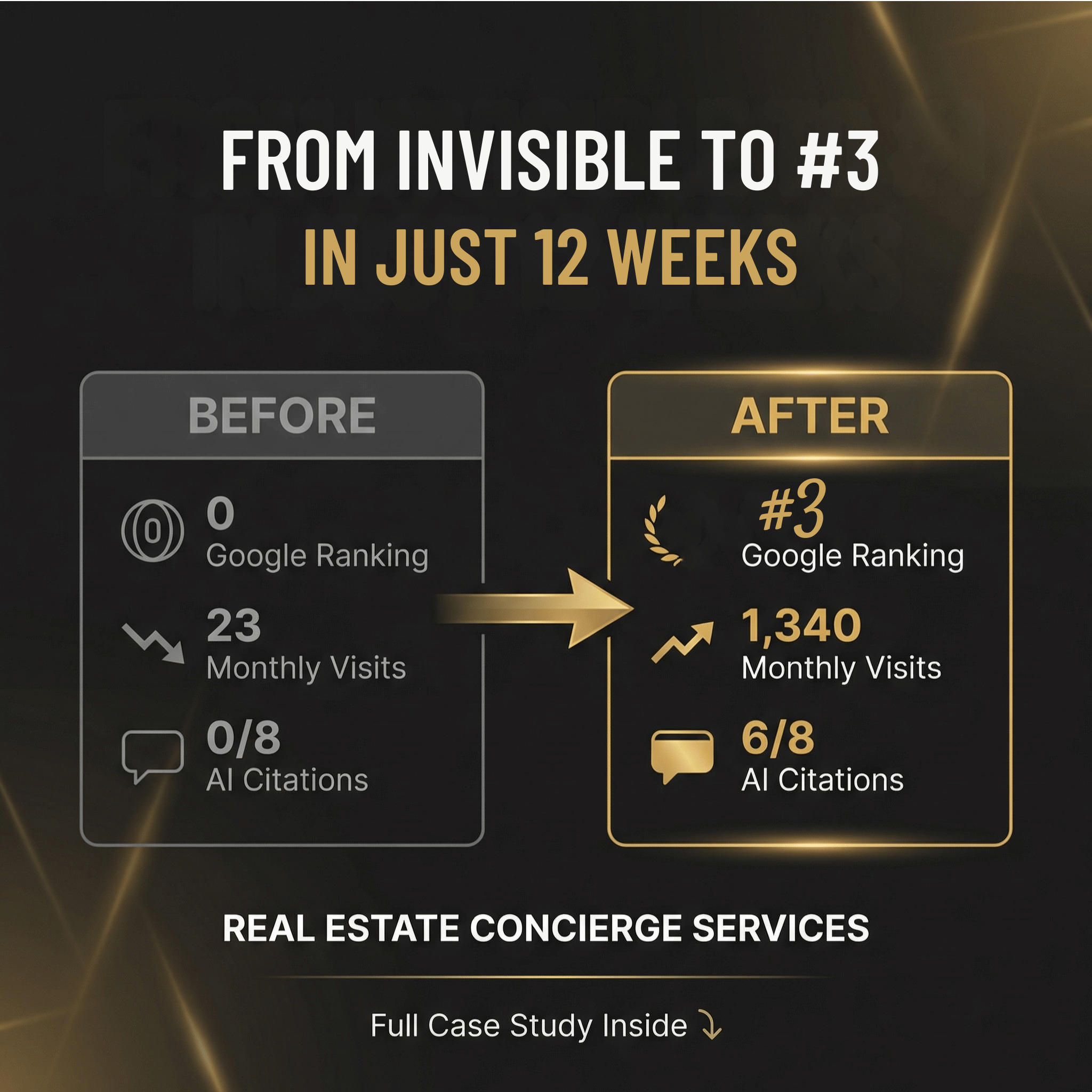
Case Study: From Invisible to #1 — How Agent Ken Dominated Local Search and AI in 12 Weeks
Case study from RECSC, from invisible to #3 in 12 weeks
Case Study: From Invisible to #3 in 12 weeks
The Starting Point: Completely Off the Map
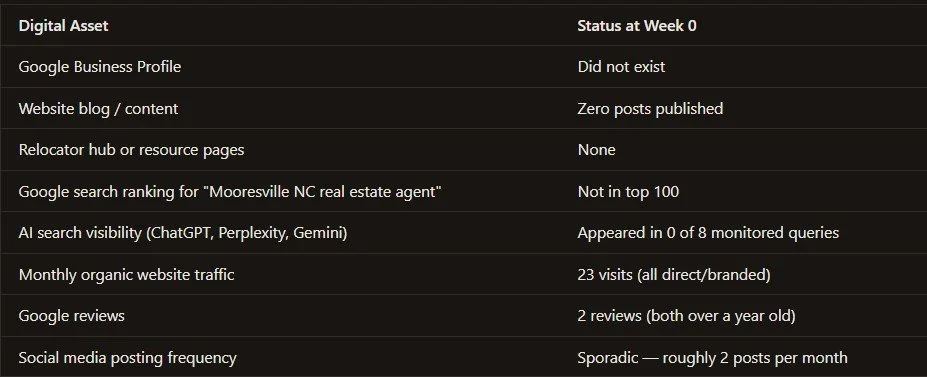
When Ken came to Real Estate Concierge Services, he had been a licensed agent in Mooresville, NC (Lake Norman) for three years. He was closing 8-10 deals a year — decent, but entirely referral-dependent. His digital presence was, to put it bluntly, nonexistent.
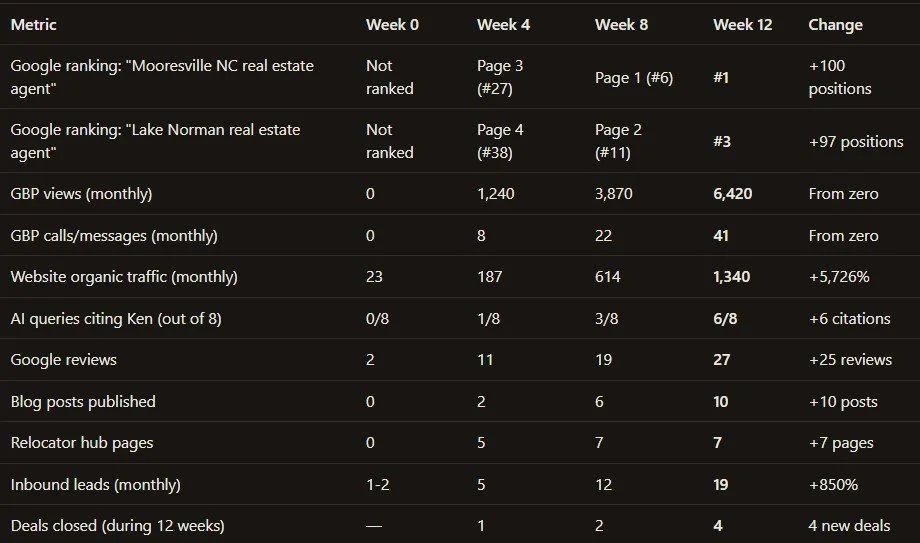
Here is what we were working with on Day 1:
The Strategy: Three Pillars, Twelve Weeks
We built Ken's visibility strategy around three pillars that compound on each other: local search dominance (Google Business Profile + reviews), content authority (weekly blogs + relocator hub), and AI search positioning (structured content designed to be cited by large language models).
Pillar 1: Google Business Profile — The Foundation
Weeks 1-2 were entirely focused on building Ken's GBP from scratch. We did not just "claim" a listing — we engineered it.
We wrote a keyword-rich business description that naturally incorporated "Mooresville NC real estate," "Lake Norman homes for sale," "waterfront properties Lake Norman," and "relocation specialist Mooresville." We uploaded 47 high-quality photos in the first week alone — exterior shots of listings, neighborhood landmarks, Lake Norman waterfront views, Ken at local businesses, and community events. Each photo was geotagged and captioned with location-specific keywords.
We set up every available GBP feature: services (buyer representation, seller listing, relocation assistance, investment properties), products (free home valuation, buyer consultation, relocation guide), Q&A (pre-populated with 12 common questions about the Mooresville and Lake Norman market), and weekly GBP posts that we maintained throughout the 12 weeks.
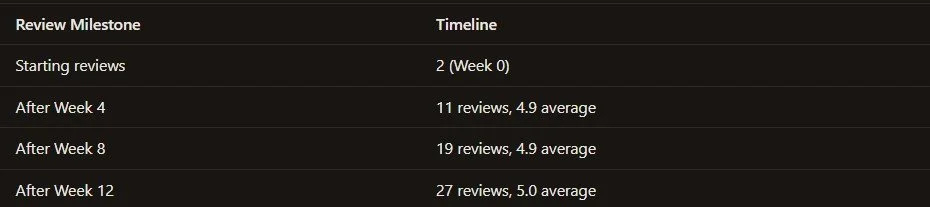
The review engine was the game-changer. We created a simple review request system for Ken: a text message template he sent to every past client, every closing, and every positive interaction. The template linked directly to his Google review page — no friction, no confusion. Ken committed to sending 5 review requests per week.
By Week 8, Ken had more reviews than 4 of the top 5 agents in the Mooresville GBP pack. By Week 12, he had the highest review count AND the highest rating in his local market.
Pillar 2: Content Authority — The Relocator Hub and Weekly Blogs
Weeks 2-4 focused on building Ken's content engine. We created a dedicated relocator hub on his website — a comprehensive resource page targeting people moving to the Lake Norman and Mooresville area.
The relocator hub included seven core pages:
"Moving to Mooresville, NC: The Complete 2026 Guide" covered cost of living comparisons (Mooresville vs. Charlotte, vs. national average), school district breakdowns (Mooresville Graded School District ratings, enrollment numbers, notable programs), neighborhood profiles (Downtown Mooresville, The Point, Morrison Plantation, Northington, Curtis Pond), commute times to Charlotte (I-77 corridor analysis, typical drive times by neighborhood), and local lifestyle highlights (Lake Norman access, restaurants, breweries, the NASCAR connection).
"Lake Norman Waterfront Homes: What Buyers Need to Know" addressed dock permits, HOA regulations for waterfront communities, price ranges by cove and location, flood zone considerations, and seasonal market trends for lakefront properties.
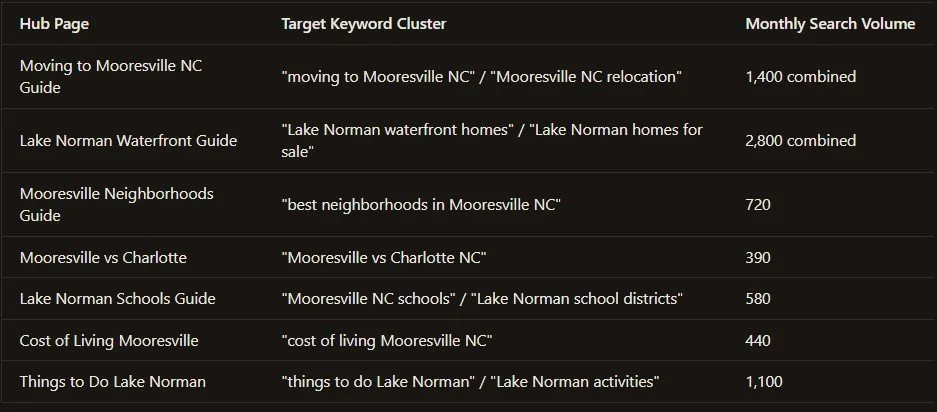
We published the remaining five hub pages over Weeks 3-4, each targeting a specific long-tail keyword cluster:
Starting in Week 3, we launched a weekly blog cadence. Every Tuesday, a new post went live — each one targeting a specific question that potential buyers and relocators were searching for. The blog topics were selected using a combination of Google's "People Also Ask" data, Perplexity's trending queries, and keyword research from Ahrefs.
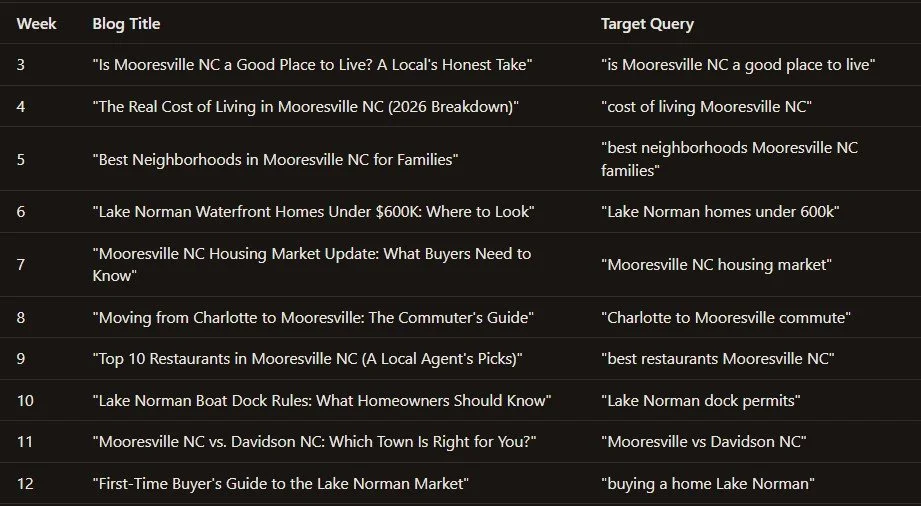
Here is the 12-week blog calendar we executed:
Each blog post followed a specific structure designed for both Google and AI search: a direct answer to the query in the first paragraph (for featured snippets and AI citations), structured headers using H2 and H3 tags, local data and statistics with cited sources, internal links to the relocator hub pages, and a clear CTA to contact Ken.
Pillar 3: AI Search Positioning — The Invisible Advantage
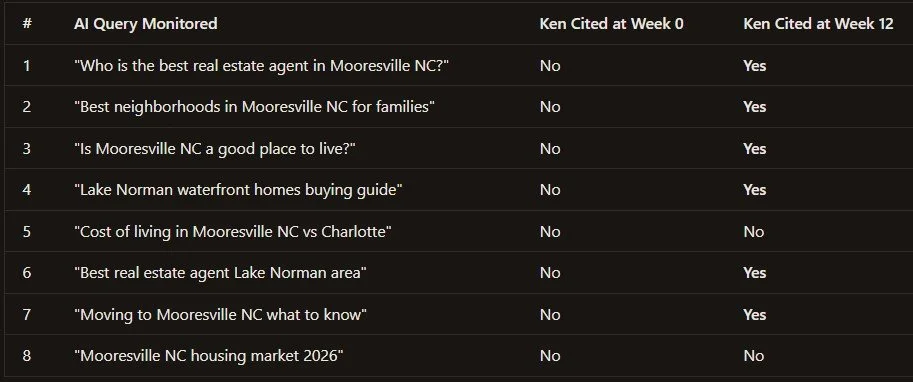
This is where the strategy separated Ken from every other agent in his market. Starting in Week 1, we identified 8 AI search queries that a potential buyer or relocator would ask ChatGPT, Perplexity, or Google's AI Overview:
6 out of 8 queries cited Ken or his content by Week 12. The two misses (queries 5 and 8) were dominated by large media outlets (Niche.com and Realtor.com) — but even on those, Ken's blog posts appeared in the source links that the AI models referenced.
The AI positioning strategy was not separate from the content strategy — it was embedded in it. Every blog post and hub page was written with AI citation in mind:
We used direct, authoritative answer structures in the opening paragraph of every post. Instead of "In this article, we'll explore..." we wrote "Mooresville, NC is one of the fastest-growing towns in the Charlotte metro, with a median home price of $425,000 and a population that has grown 23% since 2020." AI models pull from content that directly answers questions.
We embedded structured data markup (Schema.org) on every page — LocalBusiness schema on the homepage, FAQPage schema on the relocator hub, Article schema on every blog post, and RealEstateAgent schema on Ken's about page. This gave AI crawlers clean, parseable data about who Ken is and what he covers.
We built topical authority through internal linking. Every blog post linked to at least 2 other blog posts and 1 relocator hub page. The hub pages linked to each other and to the blog. This created a content web that signaled to both Google and AI models: "Ken Mercer is the definitive source for Mooresville and Lake Norman real estate information."
The Results: 12 Weeks, By the Numbers
The Revenue Impact
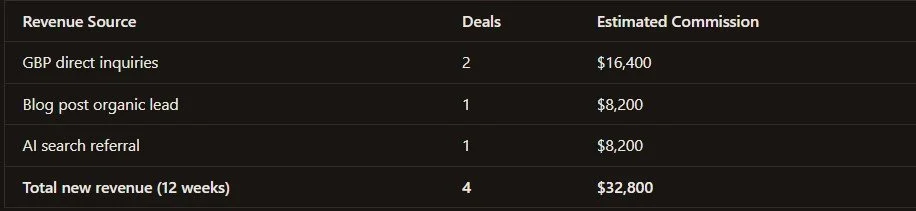
Ken's average commission per transaction in the Lake Norman market is approximately $8,200. During the 12-week engagement, he closed 4 deals that originated directly from his new digital presence — 2 from GBP inquiries, 1 from a blog post lead, and 1 from a relocator who found his hub page through a ChatGPT recommendation.
Ken's investment in the 12-week program was $4,800. His return on investment was 583% in the first 12 weeks alone — and the assets we built (GBP, blog posts, relocator hub, review engine) continue generating leads every month without additional spend.
The Compounding Effect: What Happened After Week 12
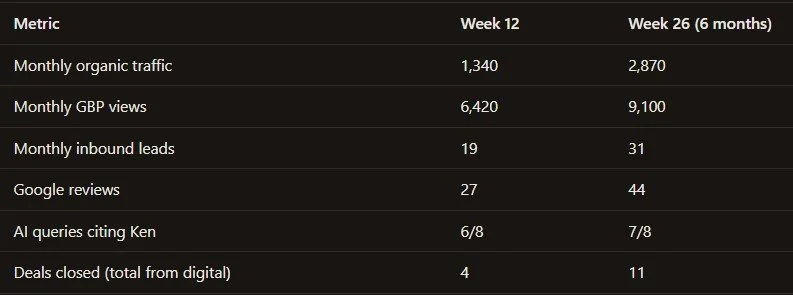
The most important thing about Ken's results is that they did not stop at Week 12. The content, the GBP, and the AI citations continue to compound. At the 6-month mark (Week 26), Ken's numbers had grown to:
Ken went from closing 8-10 referral-dependent deals per year to being on pace for 22+ deals in 2026, with more than half coming from his digital presence. He no longer wonders where his next client is coming from.
Key Takeaways for Agents
You do not need to be a tech expert. Ken did not write a single blog post himself. He did not set up his own GBP. He did not learn Schema.org markup. He showed up, sent review requests, and let the system work. The strategy was built and executed by Real Estate Concierge Services — Ken just had to say yes.
AI search is not the future — it is happening right now. One of Ken's 4 deals came directly from a ChatGPT recommendation. That buyer typed "best real estate agent in Mooresville NC" into ChatGPT, and Ken's name came up. That buyer never would have found Ken through a traditional Google search, a Zillow ad, or a cold call. AI search is a new channel, and most agents are not even in the game yet.
Content compounds. The blog post Ken published in Week 3 ("Is Mooresville NC a Good Place to Live?") is still his #1 traffic driver at the 6-month mark. It generates 340+ organic visits per month and has been cited by Perplexity 14 times. One blog post, written once, working forever.
Reviews are the multiplier. Ken's GBP ranking jumped from Page 3 to #1 largely because of his review velocity. Google's local algorithm heavily weights recent, frequent reviews. Ken went from 2 stale reviews to 27 fresh ones in 12 weeks — and that velocity is what pushed him past agents who had been in the market for 15+ years.
The agents who start now win. Ken's competitors in Mooresville are still not doing this. Most of them have a GBP with 5 reviews and no posts. None of them have a relocator hub. None of them are optimizing for AI search. Ken got a 12-week head start, and that head start compounds every single day.
Ready to Build Your Visibility Engine?
Ken's transformation was not luck, and it was not magic. It was a system — the same system we build for every agent we work with at Real Estate Concierge Services.
If you are tired of being invisible, if you are tired of watching agents with half your talent outrank you online, if you are ready to show up where your clients are actually searching — we should talk.
Start with the Google Visibility Audit or Visibility Foundation to see where you stand, or access our Real Estate Concierge Marketing Hub and upgrade to All Access for the full playbook, templates, and tools that powered Ken's results.
Drop your info below if you want weekly value bombs (30 day content calendar, Visibility Guide and Checklist, Case Studies, ChatGPT prompts for realtors, Listing Launch Kits, and much more!
The Realtor Visibility Sprint: 7 Days to Fix Your Google Presence (and Convert More Leads)
Most Realtors are doing “all the things” and still not getting consistent inbound leads. This 7-day visibility sprint shows you exactly what to fix on your Google Business Profile, how to ask for reviews that help you rank, and the follow-up script that turns open house conversations into appointments.
If you are posting consistently, networking, hosting open houses, and still not getting predictable inbound leads, you do not have a work ethic problem.
You have a visibility problem.
In 2026, effort does not equal opportunity if people cannot find you at the exact moment they are searching. And that moment is usually on Google.
This post is a step-by-step sprint you can run in under an hour a day. It is designed to do two things:
Get you found more often in local search
Convert more of the leads you are already meeting (without chasing)
If you want the quick version: optimize your Google Business Profile, collect reviews that include location and outcomes, and stop sending follow-ups that end the conversation.
Let’s get you set up.
What “Visibility” Actually Means for Realtors
Visibility is not “posting more.” Visibility is being discoverable when intent is high.
Examples of high-intent searches:
“Realtor near me”
“moving to [city]”
“best neighborhoods in [city]”
“sell my house in [city]”
“[city] waterfront homes agent” (Lake Norman friends, I’m looking at you)
Google, and increasingly AI search results, rely on consistent business signals:
accurate business info
strong reviews with context
clear services
locally relevant content
If your online presence is scattered or vague, Google cannot confidently put you in front of the right people.
The 7 Day Visibility Sprint
Do these in order. Each day builds on the last.
Day 1: GBP Foundation
Open your Google Business Profile and check these three things:
1) Primary category
Be specific. “Marketing consultant” and “real estate consultant” are not the same. Your category impacts what you show up for.
2) Services
Fill out your services list with what you want to get hired for. Not what sounds fancy.
Examples:
Real estate marketing consulting
Real estate lead generation support
Google Business Profile optimization
Listing launch marketing
Relocation marketing campaigns
CRM setup and lead nurturing (HubSpot)
3) Service areas
Set service areas based on where you want business, not where you happen to be sitting when you create the profile.
Quick win: add your top 5 target areas and keep them consistent across your website and socials.
Day 2: Fix Your Business Description (This is a rankings and conversion lever)
Most GBP descriptions are either bland or stuffed with keywords. Both are a miss.
Use this structure:
Line 1: Who you help + where
Example: “Outsourced Operations and Marketing for Realtors in Raleigh and Lake Norman.”
Line 2: What you actually do
Example: “I help agents get found on Google, convert leads through follow-up systems, and turn listings into content that drives calls.”
Line 3: Proof or differentiator
Example: “Boutique, hands-on support. No fluff. Clear deliverables.”
Line 4: CTA
Example: “Message me for a quick visibility audit.”
Day 3: Photos That Build Trust and Signal Activity
Google rewards fresh activity. People reward proof.
Upload 10 new photos this week:
a clean headshot
you working, laptop, on-site, meeting, content creation
screenshots of results (blur any sensitive info)
a simple branded graphic (checklist, script, framework)
local photos (Raleigh, Lake Norman landmarks, events, streetscapes)
Tip: upload 1 to 2 photos weekly going forward. Consistency wins.
Day 4: The Review Sprint (Reviews that rank are not generic)
“Highly recommend” reviews are nice, but they do not help you rank like reviews with context.
Ask for reviews that include:
location (city, neighborhood)
service (buying, selling, relocation, marketing support)
outcome (what improved, what result happened)
Copy/paste review ask:
“If you’re comfortable, could you mention the area you’re in, what I helped you with, and the result? That helps local agents find me when they need the same support.”
Five prompts to make it easy for them:
Mention the city or neighborhood
Mention the service (GBP, content, CRM, listing launch, etc.)
Share the problem you were trying to solve
Share what felt different about working together
Share the result
Day 5: Build One Website Page That Actually Converts
Pretty websites do not convert if they do not answer the right questions.
Minimum viable “conversion” setup:
clear positioning
proof
next step
Create one page that targets a real, high-intent search:
Option A: “Google Business Profile Optimization for Realtors”
Include:
who it’s for
what’s included
common mistakes
timeline
CTA to book
Option B: “Relocation Marketing for Realtors”
Include:
what you build (guides, neighborhood content, visibility assets)
examples of deliverables
CTA
If you already have a services page, your job is to add one page that is laser-focused, not another general overview.
Day 6: Create a 3 Area Content Map (The simplest local authority play)
Pick 3 areas you want to own. Then write 3 pieces of content.
For each area:
Who it’s perfect for
Who should skip it
The tradeoff nobody says out loud
This is the kind of content that gets saved, shared, and ranked.
Day 7: Publish One “Start Here” Offer Post and Pin It
This is your lead-capture post. It should be simple and specific.
Example:
“If you’re a Realtor and your Google Business Profile is not producing calls, comment AUDIT and I’ll send you the top 3 fixes that will move the needle fast.”
Pin it on Facebook. Feature it on LinkedIn. Add it to your GBP as an Offer post.
Bonus: The Open House Follow-Up Script That Converts
Most agents send follow-ups that end the conversation.
Use a follow-up that asks one smart question:
Copy/paste:
“Hey [Name], thanks again for coming by today. Quick question: what’s the one thing you’re hoping your next move fixes or improves? More space, shorter commute, better schools, walkability, less maintenance, or something else? If you tell me that, I’ll send you 3 options that match, plus what you should watch for before you fall in love with the wrong house.”
Why it works:
it is about their life, not your schedule
it asks one easy question
it earns the right to send more value
If You Want Me to Check Your Visibility
I run a quick mini audit and send you:
3 quick fixes
the 1 thing to change first
what to post for the next 2 weeks
Comment AUDIT or message me with your market.
FAQ
How long does GBP take to improve?
If you fix categories, services, description, and start consistent posting and reviews, you can see movement within weeks. Real stability comes from consistency.
Do I need to post daily on GBP?
No. Weekly is fine. Consistent is the point.
What matters more, website or GBP?
GBP usually drives the fastest local results. Your website supports conversions and longer-term ranking.
Are generic reviews still helpful?
Yes, but specific reviews help you rank and convert better.