Case Study: From Invisible to #1 — How Agent Ken Dominated Local Search and AI in 12 Weeks
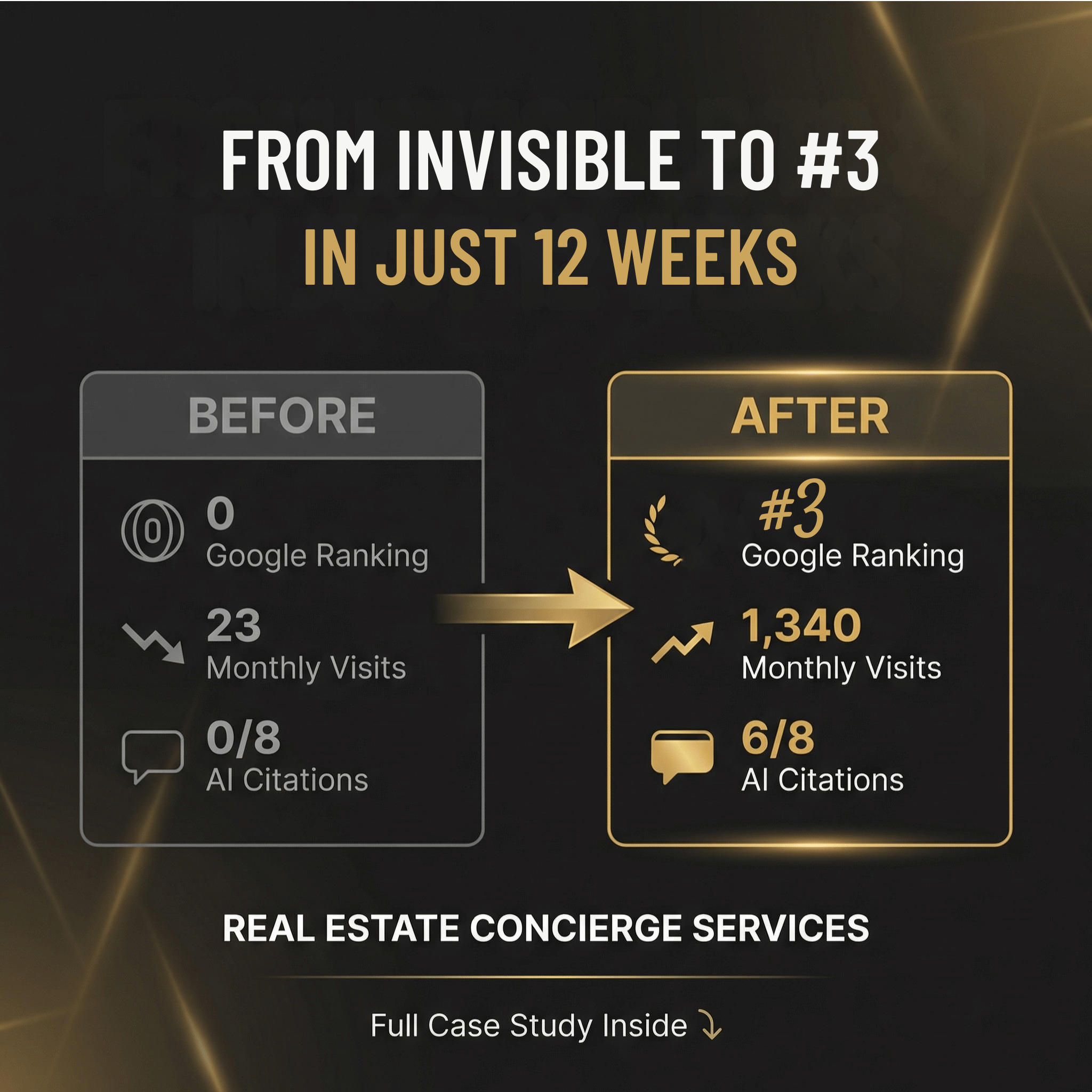
Case study from RECSC, from invisible to #3 in 12 weeks
Case Study: From Invisible to #3 in 12 weeks
The Starting Point: Completely Off the Map
When Ken came to Real Estate Concierge Services, he had been a licensed agent in Mooresville, NC (Lake Norman) for three years. He was closing 8-10 deals a year — decent, but entirely referral-dependent. His digital presence was, to put it bluntly, nonexistent.
Here is what we were working with on Day 1:
The Strategy: Three Pillars, Twelve Weeks
We built Ken's visibility strategy around three pillars that compound on each other: local search dominance (Google Business Profile + reviews), content authority (weekly blogs + relocator hub), and AI search positioning (structured content designed to be cited by large language models).
Pillar 1: Google Business Profile — The Foundation
Weeks 1-2 were entirely focused on building Ken's GBP from scratch. We did not just "claim" a listing — we engineered it.
We wrote a keyword-rich business description that naturally incorporated "Mooresville NC real estate," "Lake Norman homes for sale," "waterfront properties Lake Norman," and "relocation specialist Mooresville." We uploaded 47 high-quality photos in the first week alone — exterior shots of listings, neighborhood landmarks, Lake Norman waterfront views, Ken at local businesses, and community events. Each photo was geotagged and captioned with location-specific keywords.
We set up every available GBP feature: services (buyer representation, seller listing, relocation assistance, investment properties), products (free home valuation, buyer consultation, relocation guide), Q&A (pre-populated with 12 common questions about the Mooresville and Lake Norman market), and weekly GBP posts that we maintained throughout the 12 weeks.
The review engine was the game-changer. We created a simple review request system for Ken: a text message template he sent to every past client, every closing, and every positive interaction. The template linked directly to his Google review page — no friction, no confusion. Ken committed to sending 5 review requests per week.
By Week 8, Ken had more reviews than 4 of the top 5 agents in the Mooresville GBP pack. By Week 12, he had the highest review count AND the highest rating in his local market.
Pillar 2: Content Authority — The Relocator Hub and Weekly Blogs
Weeks 2-4 focused on building Ken's content engine. We created a dedicated relocator hub on his website — a comprehensive resource page targeting people moving to the Lake Norman and Mooresville area.
The relocator hub included seven core pages:
"Moving to Mooresville, NC: The Complete 2026 Guide" covered cost of living comparisons (Mooresville vs. Charlotte, vs. national average), school district breakdowns (Mooresville Graded School District ratings, enrollment numbers, notable programs), neighborhood profiles (Downtown Mooresville, The Point, Morrison Plantation, Northington, Curtis Pond), commute times to Charlotte (I-77 corridor analysis, typical drive times by neighborhood), and local lifestyle highlights (Lake Norman access, restaurants, breweries, the NASCAR connection).
"Lake Norman Waterfront Homes: What Buyers Need to Know" addressed dock permits, HOA regulations for waterfront communities, price ranges by cove and location, flood zone considerations, and seasonal market trends for lakefront properties.
We published the remaining five hub pages over Weeks 3-4, each targeting a specific long-tail keyword cluster:
Starting in Week 3, we launched a weekly blog cadence. Every Tuesday, a new post went live — each one targeting a specific question that potential buyers and relocators were searching for. The blog topics were selected using a combination of Google's "People Also Ask" data, Perplexity's trending queries, and keyword research from Ahrefs.
Here is the 12-week blog calendar we executed:
Each blog post followed a specific structure designed for both Google and AI search: a direct answer to the query in the first paragraph (for featured snippets and AI citations), structured headers using H2 and H3 tags, local data and statistics with cited sources, internal links to the relocator hub pages, and a clear CTA to contact Ken.
Pillar 3: AI Search Positioning — The Invisible Advantage
This is where the strategy separated Ken from every other agent in his market. Starting in Week 1, we identified 8 AI search queries that a potential buyer or relocator would ask ChatGPT, Perplexity, or Google's AI Overview:
6 out of 8 queries cited Ken or his content by Week 12. The two misses (queries 5 and 8) were dominated by large media outlets (Niche.com and Realtor.com) — but even on those, Ken's blog posts appeared in the source links that the AI models referenced.
The AI positioning strategy was not separate from the content strategy — it was embedded in it. Every blog post and hub page was written with AI citation in mind:
We used direct, authoritative answer structures in the opening paragraph of every post. Instead of "In this article, we'll explore..." we wrote "Mooresville, NC is one of the fastest-growing towns in the Charlotte metro, with a median home price of $425,000 and a population that has grown 23% since 2020." AI models pull from content that directly answers questions.
We embedded structured data markup (Schema.org) on every page — LocalBusiness schema on the homepage, FAQPage schema on the relocator hub, Article schema on every blog post, and RealEstateAgent schema on Ken's about page. This gave AI crawlers clean, parseable data about who Ken is and what he covers.
We built topical authority through internal linking. Every blog post linked to at least 2 other blog posts and 1 relocator hub page. The hub pages linked to each other and to the blog. This created a content web that signaled to both Google and AI models: "Ken Mercer is the definitive source for Mooresville and Lake Norman real estate information."
The Results: 12 Weeks, By the Numbers
The Revenue Impact
Ken's average commission per transaction in the Lake Norman market is approximately $8,200. During the 12-week engagement, he closed 4 deals that originated directly from his new digital presence — 2 from GBP inquiries, 1 from a blog post lead, and 1 from a relocator who found his hub page through a ChatGPT recommendation.
Ken's investment in the 12-week program was $4,800. His return on investment was 583% in the first 12 weeks alone — and the assets we built (GBP, blog posts, relocator hub, review engine) continue generating leads every month without additional spend.
The Compounding Effect: What Happened After Week 12
The most important thing about Ken's results is that they did not stop at Week 12. The content, the GBP, and the AI citations continue to compound. At the 6-month mark (Week 26), Ken's numbers had grown to:
Ken went from closing 8-10 referral-dependent deals per year to being on pace for 22+ deals in 2026, with more than half coming from his digital presence. He no longer wonders where his next client is coming from.
Key Takeaways for Agents
You do not need to be a tech expert. Ken did not write a single blog post himself. He did not set up his own GBP. He did not learn Schema.org markup. He showed up, sent review requests, and let the system work. The strategy was built and executed by Real Estate Concierge Services — Ken just had to say yes.
AI search is not the future — it is happening right now. One of Ken's 4 deals came directly from a ChatGPT recommendation. That buyer typed "best real estate agent in Mooresville NC" into ChatGPT, and Ken's name came up. That buyer never would have found Ken through a traditional Google search, a Zillow ad, or a cold call. AI search is a new channel, and most agents are not even in the game yet.
Content compounds. The blog post Ken published in Week 3 ("Is Mooresville NC a Good Place to Live?") is still his #1 traffic driver at the 6-month mark. It generates 340+ organic visits per month and has been cited by Perplexity 14 times. One blog post, written once, working forever.
Reviews are the multiplier. Ken's GBP ranking jumped from Page 3 to #1 largely because of his review velocity. Google's local algorithm heavily weights recent, frequent reviews. Ken went from 2 stale reviews to 27 fresh ones in 12 weeks — and that velocity is what pushed him past agents who had been in the market for 15+ years.
The agents who start now win. Ken's competitors in Mooresville are still not doing this. Most of them have a GBP with 5 reviews and no posts. None of them have a relocator hub. None of them are optimizing for AI search. Ken got a 12-week head start, and that head start compounds every single day.
Ready to Build Your Visibility Engine?
Ken's transformation was not luck, and it was not magic. It was a system — the same system we build for every agent we work with at Real Estate Concierge Services.
If you are tired of being invisible, if you are tired of watching agents with half your talent outrank you online, if you are ready to show up where your clients are actually searching — we should talk.
Start with the Google Visibility Audit or Visibility Foundation to see where you stand, or access our Real Estate Concierge Marketing Hub and upgrade to All Access for the full playbook, templates, and tools that powered Ken's results.
Drop your info below if you want weekly value bombs (30 day content calendar, Visibility Guide and Checklist, Case Studies, ChatGPT prompts for realtors, Listing Launch Kits, and much more!
How to Optimize Your Google Business Profile as a Real Estate Agent
Google Business Profile optimization dashboard for real estate agents
By Emily Wyatt, Fractional Marketing Partner for Real Estate Agents
Most real estate agents think they have a marketing problem. If you still know it as Google My Business, same tool, new name — Google rebranded it to Google Business Profile in 2022, but the strategy behind it has evolved even more than the name. What they actually have is a visibility problem. You can post on Instagram every day, pay for leads, and have a beautiful website, but if someone Googles “real estate agent near me” and you don’t show up, you are functionally invisible.
Your Google Business Profile (GBP) is the single most powerful tool you have for capturing local, high-intent search traffic. It’s not a digital business card; it’s a local search engine that works for you 24/7. Optimizing it correctly is the difference between getting calls from motivated locals and being completely outranked by the agent down the street.
This is the definitive, step-by-step guide to optimizing your Google Business Profile for real estate in 2026. No fluff, no generic advice—just the strategic process I use to make my clients the most findable agents in their market.
Why Your Google Business Profile Matters More Than Your Website Right Now
Social media builds familiarity, but Google captures intent. Someone scrolling Instagram might like your post. Someone Googling “realtor in Raleigh NC” is ready to act. This is why Google traffic converts differently and why agents who dominate local search don’t feel the same pressure to constantly chase leads.
Your Google Business Profile is where trust is decided before a conversation ever happens. It’s your digital storefront, review hub, and service menu all in one, and it’s the first impression most prospects will have of your business.
Step 1: Claim and Verify Your Profile
Before you can optimize, you must have control. If you haven’t already, go to google.com/business to claim or create your profile. Verification is typically done via a postcard sent to your business address to confirm your location, though Google sometimes offers phone or email verification. This step is non-negotiable.
Step 2: Choose the Right Primary and Secondary Categories
This is one of the most critical ranking factors and where most agents make their first mistake. Your Primary Category must be Real Estate Agent. Not “Real Estate Agency” (unless you are a brokerage), not “Real Estate,” but the specific practitioner category.
Where you gain an edge is in your Secondary Categories. These tell Google about the full scope of your expertise. Add every relevant category, such as:
•Real Estate Agency
•Real Estate Consultant
•Real Estate Appraiser
•Commercial Real Estate Agency
•Real Estate Rental Agency
•Property Management Company
Choosing the right categories is a direct signal to Google about which searches your profile is qualified to rank for. Don’t skip this.
Step 3: Write a Keyword-Rich Business Description
Your business description is 750 characters of prime SEO real estate. Do not waste it on fluffy brand statements. Write a clear, concise, and keyword-rich summary of who you help, where you help them, and what you specialize in.
Use this template:
[Your Name/Team Name] is a [primary specialty, e.g., top-producing real estate agent] serving [City, State] and the surrounding [Region, e.g., Triangle area]. We specialize in [niche 1, e.g., helping first-time homebuyers], [niche 2, e.g., luxury listings], and [niche 3, e.g., relocation services to Raleigh]. With over [X] years of experience and a commitment to [your value proposition, e.g., data-driven marketing and client education], we guide our clients through every step of the buying and selling process. Contact us for a no-pressure consultation.
This structure tells Google your location, your specialties, and your value, all while using the natural language your clients use in search.
Step 4: Build Out Your Services and Products Sections
This is the area most agents ignore, and it’s a massive missed opportunity. It’s how you turn your profile from a simple listing into an interactive service menu.
•Services Section: Add every single service you offer with a detailed description. Don’t just list “Buyer Representation.” Create entries for “First-Time Homebuyer Consultation,” “Seller Listing Services,” “Relocation Services,” “Local Market Analysis,” and “Luxury Property Marketing.” For each service, write a 300-character description explaining the value and what’s included.
•Products Section: This is not just for e-commerce. Use the Products section to feature your listings, lead magnets, or core services. Create a “product” for each of your current listings with high-quality photos and a link to the listing page. Create another “product” for your “Free Relocation Guide” that links to a landing page. This gives users a direct, visual path to your most valuable content.
Step 5: Set Up Your Service Areas Strategically
Your service areas tell Google your geographic footprint. Be specific. Instead of just listing “Raleigh, NC,” add the specific neighborhoods you specialize in (e.g., “North Hills,” “Oakwood,” “Brier Creek”). If you serve multiple towns, list them all. The more specific your service areas, the more likely you are to show up in hyperlocal searches like “realtor in North Hills Raleigh.”
Step 6: Add and Maintain High-Quality Photos
Photos are a trust signal and a ranking factor. A profile with a robust, frequently updated photo library will always outperform a barren one. Your goal is to have at least 10-15 high-quality images across these categories:
•Profile Photo: A professional, high-resolution headshot.
•Cover Photo: A branded image or a stunning shot of a local landmark or property.
•Listing Photos: Interior and exterior shots of your best current or sold properties.
•Team Photos: Professional shots of you and your team.
•Community Photos: Pictures you’ve taken of local parks, restaurants, and neighborhoods to establish local authority.
Name your image files with relevant keywords before uploading (e.g., raleigh-nc-real-estate-agent-emily-wyatt.jpg).
Step 7: Create a Weekly Google Post Strategy
Google Posts are mini-blog posts that appear directly on your profile. They expire every seven days, so consistency is key. A weekly posting cadence keeps your profile active, which Google rewards. Use these post types:
•What’s New: Share market updates, new blog posts, or community news.
•Offers: Promote a free home valuation, a new lead magnet, or a consultation offer.
•Events: Announce open houses, webinars, or community events you’re hosting.
Rotate through these themes weekly to keep your content fresh and engaging.
Step 8: Build a Review Strategy That Compounds
Reviews are the engine of local SEO. They provide social proof and are a top-three ranking factor. Your strategy should have two parts:
1.Acquisition: The best time to ask for a review is right after a successful closing. Send a direct link to your GBP review form in your follow-up email. Make it as easy as possible for happy clients to share their experience.
2.Response: Respond to every single review—positive and negative. For positive reviews, thank the client by name and mention a specific detail from your work together. For negative reviews, respond professionally, take the conversation offline, and show that you are committed to resolving issues. Your responses are visible to all future prospects.
Step 9: Use the Q&A Section Proactively
Don’t wait for people to ask questions; load the Q&A section yourself with the questions you get asked most often. This is your chance to control the narrative and overcome objections before they even arise.
Click “Ask a question” on your own profile and then answer it from your business account. Add 5-10 of your most frequently asked questions, such as:
•“What are your commission rates?”
•“How do you market your listings?”
•“Do you work with first-time homebuyers?”
•“What areas do you serve?”
Step 10: Align Your GBP with Your Website and Citations
Consistency is currency for Google. Your business name, address, and phone number (NAP) must be identical across your Google Business Profile, your website, and other online directories (like Yelp, Zillow, Realtor.com). Any inconsistency erodes Google’s trust in your data and can harm your rankings.
Ensure the website URL on your GBP links to your homepage and that your homepage clearly displays your NAP information in the footer.
Step 11: Track What Is Working with GBP Insights
Your GBP Insights dashboard is a goldmine of data. Pay attention to:
•How users searched for your business: Are they finding you through branded search (your name) or discovery search (e.g., “realtor near me”)? An increase in discovery searches means your optimization is working.
•Where users view your business on Google: Maps or Search?
•User actions: Are they calling you, visiting your website, or requesting directions? This tells you what your most valuable conversion actions are.
Check your insights monthly to understand what’s working and where to focus your efforts.
What Most Agents Get Wrong (And What to Fix First)
Having audited hundreds of real estate agent profiles, I see the same mistakes over and over:
1.Incorrect Primary Category: Choosing “Real Estate Agency” instead of “Real Estate Agent.”
2.Empty Services Section: Failing to detail their service offerings.
3.No Posting Strategy: Letting the profile sit dormant for months.
4.Ignoring Reviews: Not responding to reviews, leaving social proof on the table.
5.Generic Description: Wasting the 750-character description on fluff.
Fixing these five things will put you ahead of 90% of your competition.
When to DIY vs. When to Hire a GBP Expert
You can and should handle the basics of your profile yourself—responding to reviews, uploading photos, and creating weekly posts are all manageable tasks. However, the initial strategic setup and deep optimization—category selection, service build-out, keyword strategy, and citation alignment—is where professional expertise makes a significant difference.
If your profile is set up correctly, you can maintain it in about 30 minutes a week. If you’re not sure whether your foundation is solid, that’s when an audit is the best investment you can make.
Want a personalized review of your Google Business Profile? My Google Visibility Audit provides a prioritized action plan to fix what’s holding your rankings back. It’s a one-time fee, and if you move forward with my optimization services, the audit cost is credited back to you.
Frequently Asked Questions
(H3) How often should a real estate agent post on Google Business Profile?
A real estate agent should post on their Google Business Profile at least once a week. Google Posts expire every seven days, so a weekly cadence ensures your profile remains active, which is a positive signal to Google’s ranking algorithm. A consistent strategy involves rotating through post types like market updates, new listings, open house announcements, and real estate tips.
What is the best primary category for a Realtor on Google Business Profile?
The best and correct primary category for an individual Realtor on Google Business Profile is “Real Estate Agent.” If you are a brokerage, you should use “Real Estate Agency.” Using the correct practitioner-level category is critical for showing up in the right local searches.
Do Google Business Profile reviews affect local search rankings?
Yes, absolutely. The quantity, quality (star rating), and frequency of your Google reviews are among the most important ranking factors for local search. Google uses reviews as a strong signal of a business’s authority and trustworthiness. Furthermore, responding to reviews also appears to be a positive ranking signal.
Can I optimize my Google Business Profile myself or do I need to hire someone?
You can perform many basic optimization tasks yourself, such as completing your profile information, uploading photos, creating weekly posts, and responding to reviews. However, strategic optimization—including advanced category selection, building out services and products, local keyword strategy, and ensuring NAP consistency across all online directories—often requires expertise. A good approach is to hire a professional for an initial audit and strategic setup, then handle the weekly maintenance yourself.
How long does it take to see results from Google Business Profile optimization?
While some changes can have an immediate impact (like correcting an inaccurate business name or phone number), most significant results from Google Business Profile optimization take time to materialize. You can typically expect to see noticeable movement in your local search rankings and an increase in profile views and actions (calls, website clicks) within 30 to 90 days of implementing a consistent optimization and posting strategy.