


AI and SEO Are Not Separate Anymore. Realtors Need to Understand the New Visibility Hierarchy.
AI search and SEO are no longer separate conversations. For Realtors, visibility now depends on entity clarity, useful content, local authority, reviews, website structure, schema, and consistency across the entire digital footprint.
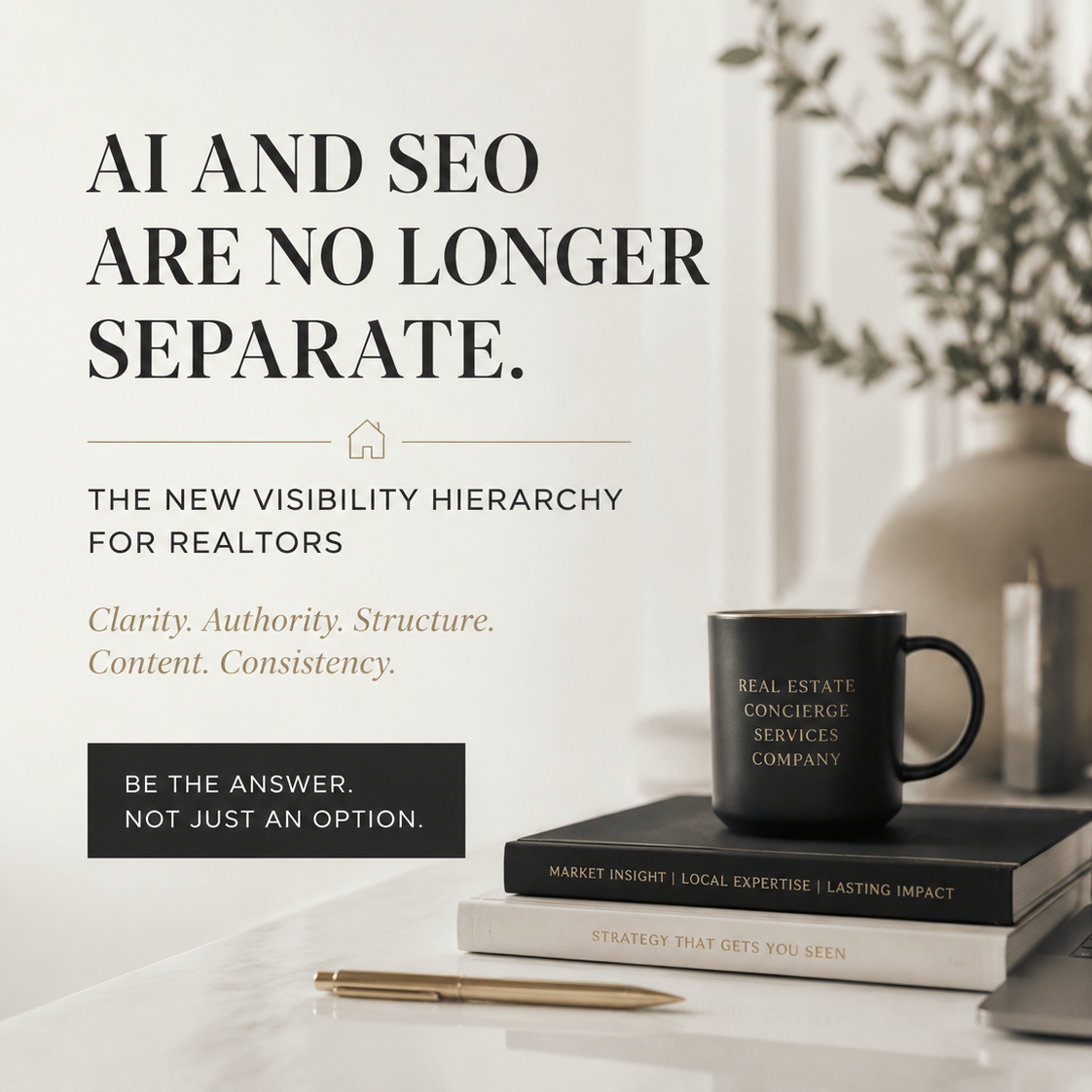
A lot of real estate agents are still treating AI and SEO like they are two separate conversations.
They are not.
That is the part the industry has not caught up to yet.
Agents keep talking about SEO like it belongs in one bucket and AI like it belongs in another. SEO is the Google thing. AI is the future thing. Website rankings are one conversation. ChatGPT recommendations are another.
That is not how this is going to work.
Actually, it is already not how it works.
Google is becoming more AI-driven. AI-generated answers are showing up inside search. ChatGPT, Perplexity, Gemini, and other answer engines are shaping how people find information. And studies are already showing something important: the sources cited by AI are not always the same pages ranking at the top of traditional Google search.
That matters.
Because for Realtors, visibility used to be easier to understand.
You wanted to rank on Google.
You wanted your website to show up.
You wanted your Google Business Profile to appear in local search.
You wanted reviews.
You wanted people to find you when they searched for an agent in your area.
All of that still matters.
But now the better question is not only:
“Do I rank on Google?”
The better question is:
“Is my business clear enough, useful enough, trusted enough, and structured enough to be pulled into the answer?”
Because AI is not just showing people a list of links.
It is trying to answer the question.
And when someone asks, “Who is a good Realtor in Raleigh?” or “Who should I use to sell my home in Cary?” or “Best real estate agent for relocating to Lake Norman?” the system is not thinking like a human referral partner.
It is looking for signals.
Patterns.
Evidence.
Clarity.
Consistency.
Useful information.
Trust.
And that is where most agents are not ready.
AI Is Not Replacing SEO. It Is Expanding What SEO Means.
I keep hearing agents say some version of:
“I’m focused on SEO right now. I’ll worry about AI later.”
That sounds practical.
But it misses the shift.
AI search is not some separate future channel that will show up one day and politely wait for you to get ready.
AI is already becoming part of search.
Google search is already more AI-driven. AI tools are already being used by buyers, sellers, relocating families, investors, and curious homeowners. People are not only typing into search bars anymore. They are asking full questions.
They are asking:
“Where should I move in the Triangle if I want good schools and a 30-minute commute?”
“What should I know before buying in Raleigh?”
“Who are the best real estate agents for relocation in Mooresville?”
“What neighborhoods near Cary are good for families?”
“How do I sell a home while buying another one?”
“What should I ask a listing agent before hiring them?”
Those are not just keyword searches.
Those are answer-seeking searches.
That means your visibility can no longer depend only on having a website with some keywords on it.
You need a full visibility system.
SEO did not die.
It got folded into something bigger.
The New Realtor Visibility Hierarchy
If a real estate agent wants to show up in AI search, Google search, local search, and answer engines, there is a hierarchy.
Not everything matters equally at the same stage.
And no, this does not mean every agent needs to become an AI expert.
It means your digital footprint has to be built in a way that search engines and AI systems can understand.
Here is the hierarchy.
1. First, Your Basic Business Identity Has to Be Clear
Before AI can recommend you, it has to understand who you are.
That sounds obvious.
It is not.
A lot of agents have messy, scattered, inconsistent online footprints.
Their website says one thing. Their Google Business Profile says another. Their Zillow bio is outdated. Their LinkedIn barely explains what market they serve. Their brokerage page is thin. Their social profiles are vague. Their reviews mention “great to work with” but not where they work, what type of client they helped, or what they are known for.
To a human, that might be fine.
To a search engine or AI tool, it is weak evidence.
The foundation starts with the basics:
Your name.
Your business name.
Your brokerage.
Your location.
Your service areas.
Your specialties.
Your website.
Your reviews.
Your online profiles.
Your contact information.
Your bio.
Your services.
Your niche, if you have one.
Your markets.
Your client types.
This is the identity layer.
It answers the most basic question:
“Who is this person, and what are they associated with?”
For Realtors, this matters because the business is local. Search engines and AI tools need to understand not just that you are a Realtor, but where you work and what kind of real estate work you should be connected to.
A Raleigh listing agent, a Lake Norman relocation agent, a Goldsboro military relocation agent, and a Cary luxury agent should not have the same digital footprint.
If they do, the system has no reason to distinguish them.
2. Then, Your Google Business Profile Has to Support the Same Story
For Realtors, your Google Business Profile is not optional.
It is one of the clearest local trust signals you have.
But most agents treat it like a directory listing.
They claim it, add a headshot, maybe get a few reviews, and then forget about it.
That is not optimization.
Your Google Business Profile should reinforce the same story your website tells.
That includes:
Correct categories.
Clear services.
Accurate service areas.
Strong reviews.
Regular posts.
Useful photos.
Questions and answers.
A complete business description.
Consistent contact information.
A link to the right page on your website.
And review language that gives Google and AI more context.
Not fake keyword stuffing. Not weird robotic review requests. Real context.
For example, a review that says:
“She was amazing.”
is nice.
But a review that says:
“She helped us relocate from New Jersey to Raleigh, explained the neighborhoods, helped us compare Cary and Apex, and guided us through a competitive offer process.”
is much more useful.
That review tells a story.
It connects the agent to relocation, Raleigh, Cary, Apex, buyer representation, neighborhood knowledge, and competitive offers.
That is the kind of evidence search systems can understand.
3. Then, You Need Valuable Content That Proves Actual Expertise
This is where agents usually go wrong.
They hear “content” and think:
“I need to post more.”
Not necessarily.
More weak content does not help much.
Random posts do not build authority.
Generic “5 tips for buyers” content does not separate you from anyone. Everyone has written that. Everyone has posted that. AI can generate that in half a second.
The content that matters now is content that proves you understand your market and your clients.
For Realtors, that means content like:
Market explanations.
Neighborhood insights.
Relocation guides.
Seller education.
Buyer process breakdowns.
Local comparison content.
Community-specific advice.
Listing preparation guidance.
Home search strategy.
Move-up buyer content.
Downsizing content.
New construction guidance.
Military relocation content.
Lake lifestyle content.
School and commute comparison content.
Real answers to real questions.
The kind of questions people ask before they ever call an agent.
That is the difference between content for activity and content for visibility.
Activity content says, “I posted today.”
Visibility content says, “This agent has useful, specific knowledge tied to a market and a client need.”
That second kind is what search engines and AI tools can use.
4. Then, Your Website Has to Be Structured So Machines Can Understand It
Good content still needs structure.
This is where SEO and AI visibility overlap hard.
A lot of agents have content, but it is floating around with no organization. Blog posts are disconnected. Service pages are missing. Local pages are thin. Internal links are weak. The homepage is trying to do everything.
That makes it harder for Google.
It also makes it harder for AI tools.
Your website should make the relationships obvious.
What services do you offer?
What markets do you serve?
What types of clients do you help?
What topics do you have authority on?
Which pages are most important?
How does one page connect to another?
For Realtors, structure can include:
A clear homepage.
A strong bio/about page.
Service pages.
Buyer pages.
Seller pages.
Relocation pages.
Neighborhood or market pages.
Google Business Profile alignment.
Local SEO pages.
Helpful educational content.
Internal links between related pages.
Clear page titles.
Clear headings.
Schema markup.
Consistent calls to action.
This is not just “technical SEO.”
This is translation.
You are translating your expertise into a format Google and AI can understand.
If your website says “I help buyers and sellers in the Triangle,” but has no supporting pages, no local content, no internal links, no service structure, and no evidence of market knowledge, then the system has very little to work with.
You might be excellent.
But excellence that cannot be understood online does not travel very far.
5. Then, You Need Authority Signals Outside Your Own Website
AI is not only looking at what you say about yourself.
It is looking for patterns across the web.
That means third-party signals matter.
Reviews matter.
Directory profiles matter.
Brokerage pages matter.
Local mentions matter.
Podcast appearances matter.
Guest features matter.
Community involvement matters.
Social profiles matter.
Consistent bios matter.
Your business showing up in multiple credible places matters.
This is where Realtors need to stop thinking of online presence as “my website and my Instagram.”
Your website is one piece.
Your Google Business Profile is one piece.
Your Zillow profile, Realtor.com profile, Homes.com profile, LinkedIn profile, brokerage bio, YouTube channel, podcast guest page, local articles, association profiles, and review platforms are all pieces.
Not every platform matters equally.
But consistency matters.
If your website says you specialize in relocation to Raleigh, but none of your other profiles mention relocation, your reviews do not mention relocation, your content does not mention relocation, and your Google profile does not support it, then your claim is weak.
AI is looking for corroboration.
It wants to see whether the broader web confirms what your website says.
That is authority.
Not in the fake guru sense.
In the evidence sense.
6. Then, Schema and Technical Signals Help Clarify the Whole Thing
Schema is not magic.
It will not save a weak website.
It will not make a generic agent suddenly dominate search.
But it does matter.
Schema helps search engines understand the type of information on a page.
For a Realtor or real estate marketing site, schema can help clarify:
Business information.
Services.
FAQs.
Local business details.
Articles.
Breadcrumbs.
Products or offers.
Reviews, where appropriate.
Author information.
Service areas.
The purpose is not to trick Google.
The purpose is to remove ambiguity.
When your content, website structure, internal links, Google profile, reviews, and schema all point in the same direction, your digital footprint becomes easier to understand.
That is the goal.
Not hacks.
Clarity.
7. Finally, Consistency Is What Turns Signals Into a Pattern
One page does not build authority.
One blog does not build authority.
One optimized Google profile does not build authority.
One LinkedIn post does not build authority.
Search visibility is built through pattern recognition.
That means the same story needs to show up repeatedly across your digital footprint.
If you are the Raleigh relocation agent, the internet should make that obvious.
If you are the listing agent for move-up sellers in Cary, the internet should make that obvious.
If you serve military families in Goldsboro, the internet should make that obvious.
If you specialize in Lake Norman lifestyle and relocation, the internet should make that obvious.
Not through spam.
Through consistency.
Your website says it.
Your content supports it.
Your Google profile reinforces it.
Your reviews mention it.
Your social content reflects it.
Your bio says it.
Your local pages prove it.
Your internal links connect it.
Your schema clarifies it.
That is the hierarchy.
That is the system.
What This Means for Realtors Right Now
The agents who are waiting to “jump on the AI bandwagon later” are misunderstanding what the bandwagon is.
This is not about using ChatGPT to write captions.
This is not about making AI headshots.
This is not about throwing “AI-powered” on a landing page.
This is about the way people find and evaluate professionals changing in real time.
Search is becoming more conversational.
Google is becoming more AI-driven.
AI tools are becoming discovery tools.
Buyers and sellers are asking more complete questions.
Relocation clients are using AI to narrow options before they ever ask a human for a referral.
And the agents who get recommended will not always be the best agents.
They will be the agents whose online presence is easiest to understand, verify, and trust.
That is the uncomfortable part.
AI does not know how hard you work.
It does not know how many clients you have helped unless that evidence exists somewhere it can understand.
It does not know you are the best agent in your market just because your past clients love you.
It needs signals.
And most Realtors have underbuilt signals.
The Future of Search Is Not Just Keywords
Keywords still matter.
But they are not enough.
The future of real estate search is built on:
Entity clarity.
Useful content.
Local authority.
Trust signals.
Technical structure.
Reviews.
Internal links.
Schema.
Consistency.
Digital footprint strength.
AI readability.
That is the new visibility stack.
And the agents who understand it early will have an advantage.
Not because they are chasing shiny objects.
Because they are building the thing that search is becoming.
The Bottom Line
AI and SEO are not separate anymore.
They are becoming one visibility system.
For Realtors, that means your website, Google Business Profile, reviews, content, local pages, service pages, online profiles, schema, and authority signals all have to work together.
Not someday.
Now.
Because the question is no longer only whether you rank.
The question is whether your business is clear enough to be chosen as the answer.
And most agents are still only building one tiny piece of the system.