Emily Wyatt Emily Wyatt

What Your Real Estate Website Is Missing (And What It's Costing You)

Your website looks fine. It's not generating leads. Here's what's actually missing — the pages, the strategy, the structure — and what it's costing you in visibility, credibility, and conversions every single month.

Your website looks fine.

That's the problem.

It has your headshot. Your brokerage logo. A search bar powered by IDX. Maybe a testimonial slider and a "Contact Me" button. It looks like a real estate website. It functions like a real estate website.

And it is doing almost nothing for your business.

I work with agents across Raleigh and Lake Norman, and I can tell you with full confidence that the majority of real estate agent websites are the most expensive business cards on the internet. They exist, but they don't work. They don't rank. They don't capture leads. They don't build trust. They don't convert.

Not because they're ugly. Because they're missing the things that actually matter.

Let's talk about what those things are.

Your Website Is Not a Brochure. It's a Visibility Engine.

Before we get into what's missing, we need to reframe what your website is supposed to do.

Most agents treat their website like a digital business card — somewhere to send people who already know their name. But in 2026, your website should be doing the opposite. It should be bringing people to you who have never heard your name.

Your website is a visibility engine. Its job is to rank in Google, feed AI search tools with structured information about your expertise, capture leads who aren't ready to call yet, and build enough trust that when they are ready, they call you and nobody else.

If your website isn't doing those four things, it doesn't matter how nice it looks. It's underperforming. And underperformance has a cost — one that compounds every month you let it sit.

The 7 Things Most Agent Websites Are Missing

1. Dedicated Neighborhood and Community Pages

This is the single biggest missed opportunity I see on agent websites. And I see it on almost every single one.

You say you're "the local expert." You claim you "know the market inside and out." But when I go to your website, there is one generic page that says "Areas I Serve" with a bulleted list of city names. No detail. No substance. No reason for Google or a potential client to believe you actually know anything about those areas.

If you want to rank for "homes for sale in North Hills Raleigh" or "moving to Mooresville NC" or "best neighborhoods in Cary for families," you need a dedicated page for each of those. Not a paragraph. A page.

Each neighborhood or community page should include a genuine overview of what it's like to live there, price ranges and market trends specific to that area, school districts and commute information, lifestyle highlights that help someone picture their life there, and internal links to your relevant services and blog content.

This is how you build local search authority. Google cannot rank you for a neighborhood you never mention beyond a bullet point. And AI search tools cannot cite you as a local expert when there is zero local content to reference.

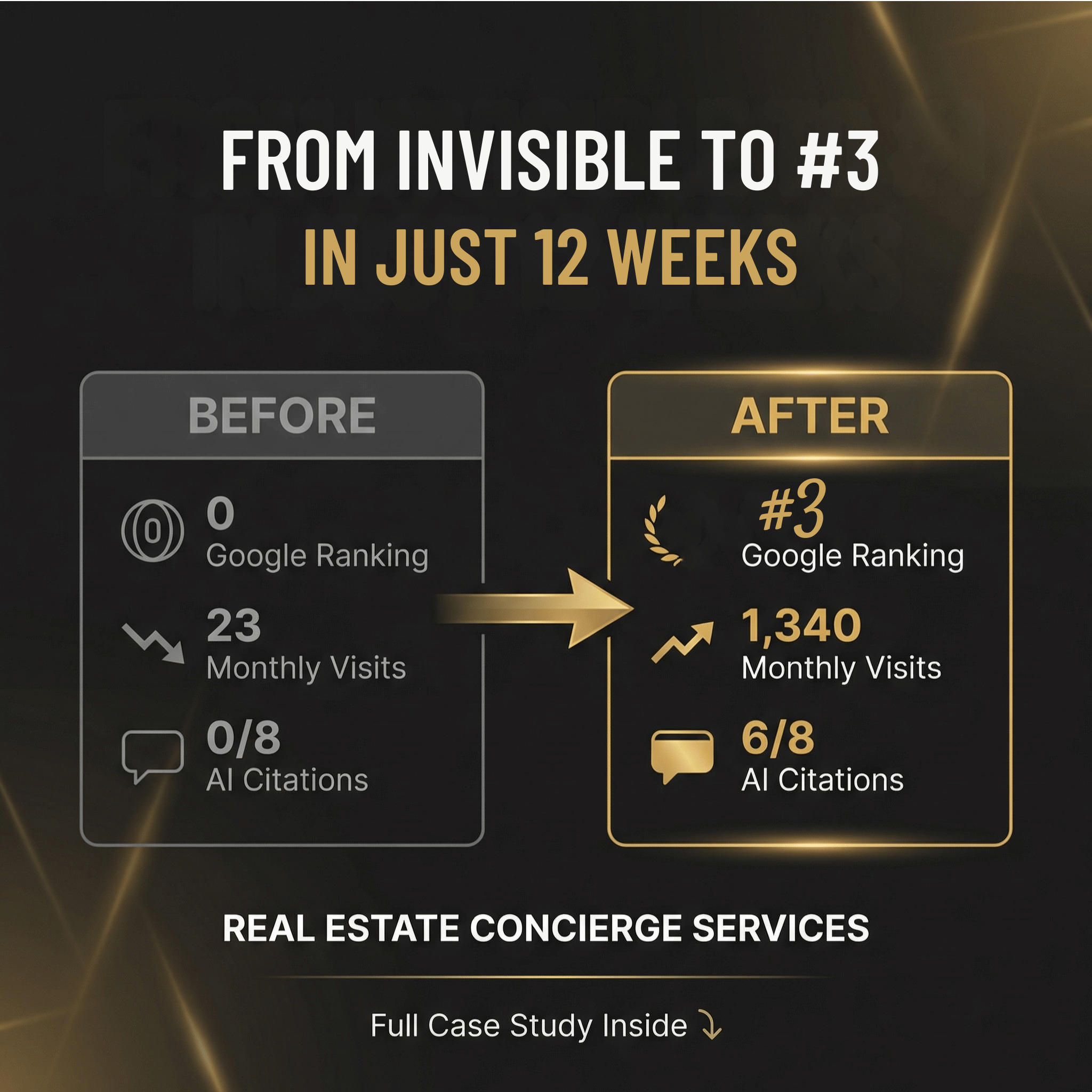
I built a relocator hub for an agent in Mooresville with seven dedicated community pages. Within 12 weeks, he went from not ranking at all to the number one position in local search. He was also cited in six out of eight AI search queries for his market. The content did the work. The pages existed. His competitors' pages did not.

If you serve Raleigh, you need pages for North Hills, Five Points, ITB, Midtown, North Raleigh, Brier Creek, and every other neighborhood where you want to win business. If you serve Lake Norman, you need pages for Mooresville, Davidson, Cornelius, Huntersville, Denver, and the waterfront communities. One page per area. Written for humans. Optimized for search.

If you want this built for you, that's exactly what the Agent Authority Website System does. →

2. A Clear Value Proposition Above the Fold

When someone lands on your homepage, they should know three things within five seconds. Who you help. Where you help them. What they should do next.

Most agent homepages fail this test immediately. They lead with a giant hero image, a brokerage logo, and a search bar. There is no positioning. No specificity. No reason for a stranger to keep scrolling.

Here is what I see constantly: "Helping you achieve your real estate goals in the Triangle area."

That tells me nothing. It tells Google nothing. It tells ChatGPT nothing.

Compare that to: "Helping first-time buyers and sellers in Raleigh's hottest neighborhoods navigate the market with local expertise, honest guidance, and a system that actually works."

Now I know who you help, where, and what makes you different. Now Google can match that to a search query. Now AI can parse your specialty and location.

Your above-the-fold copy needs to be specific, positioning-driven, and paired with a clear call to action. Not "Contact Me." Something with actual value: "Download the Raleigh Relocation Guide." "Get Your Free Home Value Report." "Book a 15-Minute Strategy Call."

The generic homepage is the most expensive mistake agents make, because every single visitor who bounces is a lead you paid for (through SEO, social, or ads) who left because your website didn't give them a reason to stay.

3. Lead Capture That Goes Beyond "Contact Me"

Let me ask you something: if I land on your website right now and I'm not ready to call you or fill out a contact form, what happens?

For most agents, the answer is nothing. I leave. You never hear from me. I am gone forever.

This is the lead leak that kills real estate businesses slowly. The vast majority of people who visit your website are not ready to talk to an agent yet. They are researching. They are comparing. They are months — sometimes a year — away from making a move. But they are interested, and if you give them something valuable, they will give you their email address.

That "something valuable" is a lead magnet. A relocation guide. A seller prep checklist. A neighborhood comparison PDF. A "What's My Home Worth" tool. A first-time buyer roadmap. Something genuinely useful that solves a real problem or answers a real question.

Once you have their email, you have a nurture path. You can send them helpful content over time. You can stay top of mind. You can be the agent they think of when they are finally ready — instead of the agent they forgot existed because your website had nothing to offer except a contact form.

Your website should have at least one lead capture mechanism on every page. Not intrusive pop-ups that annoy people. A clean, clear offer with a compelling reason to opt in.

If you're not sure what lead magnet to create, start with whatever your ideal client asks you most often. If you're a relocation specialist, create the relocation guide. If you work with sellers, create the home prep checklist. If you work with first-time buyers, create the step-by-step buyer roadmap. One asset. One opt-in. Positioned on every page.

Need help building your lead capture and nurture system? Start here. →

4. Blog Content That Answers Real Questions

Your website needs a blog. Not for vanity. Not because some marketing guru told you to. Because a blog is how you rank for the long-tail searches that bring in your highest-quality leads.

Nobody is going to your blog because they love reading about real estate marketing. They are finding your blog because they Googled "is North Hills Raleigh a good place to live" or "how much does it cost to sell a house in Cary" or "best schools near Lake Norman" — and your blog post answered their question.

Every blog post is a door. Each one opens to a different person with a different question at a different stage of their journey. The more doors you have, the more people walk in.

But most agents either have no blog at all, or they have a blog with three posts from 2023 that say things like "5 Tips for Spring Home Staging" and "Why Now Is a Great Time to Buy." That content is generic, undated, and ranking for nothing.

Your blog content should be local and specific (not "the housing market" — "the Raleigh housing market in Q2 2026"), question-driven (answer the actual queries people type into Google and AI), long-form and substantive (1,500 words minimum — depth beats frequency), internally linked to your service pages and neighborhood pages, and published on a consistent rhythm (biweekly at minimum).

One strong blog post per month that answers a real local question will outperform 30 social media posts in terms of lead generation. That is not an opinion. That is what I see in the data across every agent I work with.

5. Schema Markup and Technical SEO

This is the one nobody wants to talk about because it's not sexy. But I promise you it matters more than your font choice.

Schema markup is structured data that you add to your website's code. It tells Google and AI search tools exactly who you are, what you do, where you operate, what your reviews say, and what questions your content answers.

Without schema markup, search engines and AI have to guess what your website is about. With it, they know.

At minimum, your website should have LocalBusiness schema that includes your name, business name, address, phone number, and service areas. It should have Person schema that identifies you as a real estate agent in your market. It should have FAQ schema on any page with frequently asked questions. And it should have Review schema that makes your ratings visible in search results.

Most real estate websites have zero schema markup. Which means most agents are invisible to the fastest-growing search channel in real estate — AI-powered recommendations. When someone asks ChatGPT "Who's the best real estate agent in Raleigh?" the AI cannot recommend an agent whose website doesn't communicate clearly in the language AI understands. Schema is that language.

This is technical, and you don't need to do it yourself. But you do need to make sure it's done. If your web developer or website platform hasn't implemented schema markup, your site is operating at a fraction of its potential.

The Agent Authority Website System includes full schema implementation built for real estate. →

6. A Website That Loads Fast on Mobile

Google indexes mobile first. That means Google looks at the mobile version of your website before it ever looks at the desktop version. If your site is slow on a phone, Google penalizes you in rankings. Period.

And yet, I audit agent websites constantly that take four, five, six seconds to load on mobile. Giant uncompressed hero images. IDX widgets loading massive scripts. Brokerage-provided templates that were never optimized for speed.

Your website should load in under three seconds on mobile. You can check this right now at Google's PageSpeed Insights tool. If your score is below 70, you have a problem. If it's below 50, it's an emergency.

Site speed is not a cosmetic issue. It directly impacts your Google ranking, your user experience, and your conversion rate. Studies consistently show that every additional second of load time increases bounce rates dramatically. People leave. They don't come back. And Google notices.

The fix usually involves compressing images, removing unnecessary scripts, using a faster hosting provider, and choosing a website platform that's built for performance rather than loaded with features you don't use. This is one of those investments that pays for itself in weeks.

7.Clear Conversion Paths and Internal Linking

Even if your website has great content, it doesn't matter if there's no clear path from that content to a conversion.

I see this constantly: an agent publishes a genuinely helpful blog post. Someone finds it on Google. They read it. They learn something. And then the post just ends. No call to action. No next step. No link to a relevant service. No lead magnet. The reader closes the tab and is gone.

Every page and every blog post on your website should have a clear next step. What do you want someone to do after they read this? Book a call? Download a guide? Read a related post? Visit a service page?

Internal linking is the connective tissue of your website. It keeps people moving. It keeps them engaged. It signals to Google that your content is related and authoritative. And it creates natural pathways from "I'm just browsing" to "I need to talk to this person."

Here is a simple framework: every blog post should link to at least one service page, at least one other blog post, and at least one lead capture opportunity. Every service page should link to relevant blog content, related services, and a clear booking or contact CTA. Every page should feel like part of a system, not a dead end.

The Real Cost of a Broken Website

Let me put some numbers on this, because most agents underestimate how much a weak website costs them.

If your website gets 500 visitors per month (which is modest for an agent with any online presence at all), and your conversion rate is the industry average of about one percent, you're getting five leads per month from your site.

Now imagine your website had dedicated local pages, a compelling lead magnet, strong CTAs, and fast load times. A well-optimized real estate website converts at three to five percent. That's the same 500 visitors turning into 15 to 25 leads per month instead of five.

That's 10 to 20 additional leads per month. If even one of those converts to a transaction per month, at an average commission of $8,000 to $12,000, you're looking at $96,000 to $144,000 per year in additional revenue — from a website that's actually doing its job.

The website you have right now is not free. It's costing you every lead it doesn't capture, every search it doesn't rank for, and every AI recommendation it doesn't earn.

What an Agent Authority Website Actually Looks Like

A website that works for a real estate agent in 2026 is not a template with your photo and a search bar. It's a marketing system that runs while you sleep.

It has dedicated pages for every neighborhood and community you serve, each targeting the searches your ideal clients are making. It has a homepage that positions you clearly and captures attention in seconds. It has lead magnets and email capture on every page, feeding leads into a nurture system that builds trust over time. It has blog content that ranks for real local queries and drives organic traffic month after month. It has schema markup that tells Google and AI exactly who you are and what you're known for. It loads fast, looks sharp on mobile, and has clear conversion paths from every piece of content to a next step.

That's not a wish list. That's a standard. And it's exactly what we build.

See how the Agent Authority Website System works →

Where to Start If You Know Your Website Needs Work

If you read this and recognized your own website in more than two of these gaps, here is the order I'd fix things:

Week 1: Fix your homepage messaging. Rewrite your hero copy so it clearly states who you help, where, and what makes you different. Add a real CTA.

Week 2: Create one neighborhood page. Pick your strongest market area and build a dedicated page with real local content. Optimize it for a specific keyword.

Week 3: Add a lead magnet. Create one downloadable resource and put an opt-in on your homepage, your blog, and your new neighborhood page.

Week 4: Publish one blog post. Answer one specific question your ideal client is Googling right now. Link it to your services and your new neighborhood page.

That's four weeks of focused work, and it will put you ahead of 90 percent of the agents in your market. Because 90 percent of them have websites that look fine and do nothing.

You deserve one that works.

Not sure what your website is missing or where to start? Book a visibility auditand I'll show you exactly what's helping your brand show up — and what's holding it back.

Or if you want the entire website rebuilt right — neighborhood pages, lead capture, schema, speed, and a conversion system that runs while you're at showings — check out the Agent Authority Website System.

Emily Wyatt is the Founder of Real Estate Concierge Services Company LLC. She builds visibility systems and marketing infrastructure for real estate agents and brokerages across Raleigh and Lake Norman — so they can stop guessing and start getting found.

Part of The Agent Edge series:

Read More
Emily Wyatt Emily Wyatt

Why Raleigh Real Estate Agents Are Losing Leads to AI (And How to Fix It)

Your potential clients are asking AI for agent recommendations instead of Googling you. And when they do, your name probably doesn't come up. Here's why Raleigh is ground zero for the AI lead shift — and the 5 fixes that actually work.
Something shifted in Raleigh's real estate market this year, and most agents haven't noticed yet.

It's not interest rates. It's not inventory. It's not even the influx of out-of-state buyers (although that's still very real). It's something quieter, more fundamental, and far more disruptive.

Your potential clients are asking AI for recommendations instead of Googling you.

And when they ask ChatGPT "Who's the best listing agent in North Raleigh?" or tell Perplexity "Find me a real estate agent in Lake Norman who specializes in relocation" — your name probably doesn't come up.

Not because you're not good. Not because you don't have the reviews or the track record. But because AI doesn't know you exist.

That's the lead leak nobody's talking about. And in a market like Raleigh — where competition is fierce, transplants are flooding in from the Northeast and West Coast, and tech-savvy buyers are the norm — it's costing agents real money right now.

The Shift Nobody Saw Coming

For 20 years, the real estate lead generation playbook was simple: rank on Google, run some ads, post on social media, and work your sphere. If you showed up on page one of Google or in the Map Pack, you won.

That playbook still works — but it's no longer enough.

Here's what's changed. According to recent data, over 40% of consumers under 45 now use AI tools as their first step when researching a major purchase or service. Not Google. Not Yelp. Not Instagram. They open ChatGPT or Perplexity and ask a question in plain English.

"Who should I hire to sell my house in Cary?"

"What's the best neighborhood in Raleigh for families relocating from New York?"

"Find me a real estate agent in Mooresville who does good marketing."

These are real queries. Real people. Real leads. And the AI is answering them — with or without you.

How AI Decides Who to Recommend

Here's the part that matters: AI doesn't recommend agents the same way Google ranks websites. Google uses backlinks, keywords, and technical signals. AI uses something different — and understanding this difference is the key to getting found.

Large language models like ChatGPT, Gemini, and Perplexity build their answers from a combination of sources. They look at entity recognition, meaning how clearly and consistently you're defined as a real estate professional across the internet. They evaluate citation frequency, which is how often your name appears in authoritative contexts (articles, directories, interviews, press mentions). They assess content relevance, meaning whether you've published content that directly answers the question being asked. And they consider structured data, which refers to schema markup and metadata that helps AI understand who you are, where you work, and what you specialize in.

If you've never thought about any of these things, you're not alone. Most agents haven't. But the ones who have? They're showing up in AI answers while their competitors wonder where the leads went.

A Real Example from Raleigh

I ran an AI citation audit for an agent in the Triangle earlier this year. She's been in the business for 12 years. Great reviews. Strong Google presence. Solid social media following. By every traditional metric, she was doing everything right.

I tested ten AI queries related to real estate in her market:

  • "Best real estate agent in Raleigh NC"

  • "Top listing agent in North Raleigh"

  • "Real estate agent for relocating to Cary"

  • "Who should I hire to sell my home in Wake Forest"

  • And six more variations covering her service areas and specialties.

She appeared in zero out of ten answers. Zero.

Not because she's bad at her job - she's excellent. But because she had almost no AI-readable signals. Her website had no schema markup. She had no long-form content answering these specific questions. Her name appeared on Zillow and Realtor.com, but not on any high-authority local sites. And her Google Business Profile, while decent, wasn't structured in a way that AI could easily parse.

We spent eight weeks implementing what I call the AI Visibility Stack - a three-layer system that addresses Google visibility, AI citation authority, and content strategy simultaneously. After eight weeks, she was appearing in six out of eight AI-generated answers for her target queries.

Her phone started ringing with leads who said things like "ChatGPT recommended you" and "I asked Perplexity for the best agent in Raleigh and your name came up." These are leads she never would have gotten through traditional marketing alone.

Why Raleigh Is Ground Zero for This Shift

This isn't just a national trend — Raleigh is uniquely positioned as ground zero for the AI lead shift, and here's why.

The relocation factor. Raleigh has been one of the top relocation destinations in the country for five years running. People moving from out of state don't have a local network to ask for agent referrals. They're Googling. They're asking AI. They're relying on technology to find someone they can trust. If you're not showing up in those AI answers, you're losing relocation leads to agents who are.

The tech-savvy buyer. The Triangle is a tech hub. Research Triangle Park, the universities, the startup ecosystem — this market is full of buyers and sellers who are early adopters of AI tools. They're not just using ChatGPT for fun. They're using it for real decisions, including who to hire as their real estate agent.

The competition density. There are over 10,000 licensed real estate agents in the Triangle. In a market that crowded, traditional differentiation (nice headshots, a catchy tagline, a Zillow Premier Agent subscription) isn't enough anymore. AI visibility is the new differentiator — and right now, almost nobody in Raleigh is optimizing for it.

The Lake Norman expansion. As Raleigh's influence extends toward Charlotte and the Lake Norman corridor, agents serving both markets have an even bigger opportunity. The agents who establish AI visibility across both the Triangle and Lake Norman will dominate a massive geographic footprint.

The 5 Fixes That Actually Work

If you're a Raleigh agent reading this and thinking "I need to fix this yesterday," here's your action plan. These are the five highest-impact moves you can make, in order of priority.

Fix 1: Add Schema Markup to Your Website

This is the single fastest win. Schema markup is structured data that tells search engines and AI exactly who you are, what you do, and where you do it. Most real estate websites have zero schema markup — which means AI has to guess what your site is about.

Add LocalBusiness schema with your name, brokerage, address, phone, and service areas. Add Person schema for your agent profile. Add FAQ schema to your most important pages. And add Review schema to display your ratings in a machine-readable format.

This can be done in an afternoon, and it immediately makes your website more visible to AI models.

Fix 2: Create Question-Answering Content

AI answers questions. So create content that answers the exact questions people are asking.

Use tools like AnswerThePublic, AlsoAsked, or even ChatGPT itself to find the questions people ask about real estate in Raleigh, Cary, Apex, Wake Forest, Holly Springs, Mooresville, and every other market you serve.

Then write blog posts that answer those questions directly, thoroughly, and better than anyone else. Not 200-word fluff pieces — real, substantive, 1,500+ word articles that establish you as the authority on that topic.

"What's it like to live in North Hills Raleigh?" "How much does it cost to sell a house in Cary in 2026?" "Best neighborhoods in Lake Norman for families." These are the queries AI is answering right now. Make sure your content is what it pulls from.

Fix 3: Get Cited on Authority Sites

AI models weight mentions on high-authority websites more heavily than mentions on low-authority sites. Getting quoted in a local news article is worth more than 50 social media posts in terms of AI visibility.

Pitch yourself as a source to local media outlets like the News & Observer, Triangle Business Journal, and Charlotte Observer. Write guest posts for industry publications. Get listed on your local chamber of commerce website. Contribute to neighborhood guides on community sites.

Every authoritative mention of your name + your specialty + your location is a signal that AI models use when deciding who to recommend.

Fix 4: Optimize Your Google Business Profile for AI

Your GBP isn't just for Google Search anymore — AI models also pull from Google's data. Make sure your profile is complete (every field filled), active (posting weekly), and keyword-rich (your posts and descriptions should include your service areas and specialties naturally).

Pay special attention to your Q&A section. Add questions and answers that mirror the queries people are asking AI. "Do you work with relocation buyers?" "What areas do you serve?" "What's your marketing strategy for listings?" These Q&As become training data for AI models.

Fix 5: Build a Consistent Content Engine

AI favors recency. A website that hasn't been updated in months sends a signal that you might not be active or relevant. A website that publishes fresh, locally-targeted content every week sends the opposite signal.

You don't need to publish every day. But you do need a rhythm: one blog post every two weeks, one GBP post every week, and one long-form piece every month. That's enough to keep both Google and AI models seeing you as an active, authoritative source in your market.

The Window Is Open — But Not for Long

Here's the thing about AI visibility: it's still early. Most agents — even in a tech-savvy market like Raleigh — haven't started optimizing for it. That means the window to establish yourself as the AI-recommended agent in your market is wide open.

But it won't stay open forever. As more agents (and more marketing companies) catch on, the competition for AI citations will intensify. The agents who build their AI visibility now will have a compounding advantage that's extremely difficult to overcome later.

Think about it like Google SEO in 2010. The agents who started optimizing early dominated their markets for a decade. The ones who waited until 2015 or 2018 had to fight ten times harder for the same results.

AI visibility in 2026 is where Google SEO was in 2010. The opportunity is massive, the competition is low, and the agents who move first will win.

What to Do Right Now

If you're a Raleigh or Lake Norman agent and you want to know exactly where you stand, start with an AI citation audit. Ask ChatGPT, Perplexity, and Gemini the ten most common queries about real estate in your market. See if your name comes up. If it doesn't, you know exactly what you need to fix.

Then start with the five fixes above. Schema markup first (it's the quickest win), then content creation, then authority building. Give it eight weeks of consistent effort and audit again. You'll be amazed at the difference.

The leads are out there. The clients are asking. The only question is whether AI knows your name.

Make sure it does.

Emily Wyatt is the Founder of Real Estate Concierge Services Company LLC, helping real estate agents across Raleigh and Lake Norman build visibility systems that get them found — by Google, by AI, and by the clients who are already searching. Based in the Triangle and serving agents across North Carolina.

Want to see where you stand? Book a strategy call](https://calendly.com/ejwyatt-realtor-concierge-services/30min) and let's build your AI Visibility Stack together.

Part of The Agent Edge series:

The AI Visibility Stack: How Smart Agents Are Getting Found in 2026

5 Marketing Systems Every Solo Agent Needs Before They Hire a Team

Read More
Case Studies Emily Wyatt Case Studies Emily Wyatt

Case Study: From Invisible to #1 — How Agent Ken Dominated Local Search and AI in 12 Weeks

Case study from RECSC, from invisible to #3 in 12 weeks

Case Study: From Invisible to #3 in 12 weeks

The Starting Point: Completely Off the Map

Case Study Metrics at the start of campaign

When Ken came to Real Estate Concierge Services, he had been a licensed agent in Mooresville, NC (Lake Norman) for three years. He was closing 8-10 deals a year — decent, but entirely referral-dependent. His digital presence was, to put it bluntly, nonexistent.

Here is what we were working with on Day 1:


The Strategy: Three Pillars, Twelve Weeks

We built Ken's visibility strategy around three pillars that compound on each other: local search dominance (Google Business Profile + reviews), content authority (weekly blogs + relocator hub), and AI search positioning (structured content designed to be cited by large language models).

Pillar 1: Google Business Profile — The Foundation

Weeks 1-2 were entirely focused on building Ken's GBP from scratch. We did not just "claim" a listing — we engineered it.

We wrote a keyword-rich business description that naturally incorporated "Mooresville NC real estate," "Lake Norman homes for sale," "waterfront properties Lake Norman," and "relocation specialist Mooresville." We uploaded 47 high-quality photos in the first week alone — exterior shots of listings, neighborhood landmarks, Lake Norman waterfront views, Ken at local businesses, and community events. Each photo was geotagged and captioned with location-specific keywords.

We set up every available GBP feature: services (buyer representation, seller listing, relocation assistance, investment properties), products (free home valuation, buyer consultation, relocation guide), Q&A (pre-populated with 12 common questions about the Mooresville and Lake Norman market), and weekly GBP posts that we maintained throughout the 12 weeks.


The review engine was the game-changer. We created a simple review request system for Ken: a text message template he sent to every past client, every closing, and every positive interaction. The template linked directly to his Google review page — no friction, no confusion. Ken committed to sending 5 review requests per week.

By Week 8, Ken had more reviews than 4 of the top 5 agents in the Mooresville GBP pack. By Week 12, he had the highest review count AND the highest rating in his local market.


Pillar 2: Content Authority — The Relocator Hub and Weekly Blogs

Weeks 2-4 focused on building Ken's content engine. We created a dedicated relocator hub on his website — a comprehensive resource page targeting people moving to the Lake Norman and Mooresville area.

The relocator hub included seven core pages:

"Moving to Mooresville, NC: The Complete 2026 Guide" covered cost of living comparisons (Mooresville vs. Charlotte, vs. national average), school district breakdowns (Mooresville Graded School District ratings, enrollment numbers, notable programs), neighborhood profiles (Downtown Mooresville, The Point, Morrison Plantation, Northington, Curtis Pond), commute times to Charlotte (I-77 corridor analysis, typical drive times by neighborhood), and local lifestyle highlights (Lake Norman access, restaurants, breweries, the NASCAR connection).

"Lake Norman Waterfront Homes: What Buyers Need to Know" addressed dock permits, HOA regulations for waterfront communities, price ranges by cove and location, flood zone considerations, and seasonal market trends for lakefront properties.

We published the remaining five hub pages over Weeks 3-4, each targeting a specific long-tail keyword cluster:

Starting in Week 3, we launched a weekly blog cadence. Every Tuesday, a new post went live — each one targeting a specific question that potential buyers and relocators were searching for. The blog topics were selected using a combination of Google's "People Also Ask" data, Perplexity's trending queries, and keyword research from Ahrefs.


Here is the 12-week blog calendar we executed:

Each blog post followed a specific structure designed for both Google and AI search: a direct answer to the query in the first paragraph (for featured snippets and AI citations), structured headers using H2 and H3 tags, local data and statistics with cited sources, internal links to the relocator hub pages, and a clear CTA to contact Ken.


Pillar 3: AI Search Positioning — The Invisible Advantage

This is where the strategy separated Ken from every other agent in his market. Starting in Week 1, we identified 8 AI search queries that a potential buyer or relocator would ask ChatGPT, Perplexity, or Google's AI Overview:

6 out of 8 queries cited Ken or his content by Week 12. The two misses (queries 5 and 8) were dominated by large media outlets (Niche.com and Realtor.com) — but even on those, Ken's blog posts appeared in the source links that the AI models referenced.


The AI positioning strategy was not separate from the content strategy — it was embedded in it. Every blog post and hub page was written with AI citation in mind:

We used direct, authoritative answer structures in the opening paragraph of every post. Instead of "In this article, we'll explore..." we wrote "Mooresville, NC is one of the fastest-growing towns in the Charlotte metro, with a median home price of $425,000 and a population that has grown 23% since 2020." AI models pull from content that directly answers questions.

We embedded structured data markup (Schema.org) on every page — LocalBusiness schema on the homepage, FAQPage schema on the relocator hub, Article schema on every blog post, and RealEstateAgent schema on Ken's about page. This gave AI crawlers clean, parseable data about who Ken is and what he covers.

We built topical authority through internal linking. Every blog post linked to at least 2 other blog posts and 1 relocator hub page. The hub pages linked to each other and to the blog. This created a content web that signaled to both Google and AI models: "Ken Mercer is the definitive source for Mooresville and Lake Norman real estate information."

The Results: 12 Weeks, By the Numbers


The Revenue Impact

Ken's average commission per transaction in the Lake Norman market is approximately $8,200. During the 12-week engagement, he closed 4 deals that originated directly from his new digital presence — 2 from GBP inquiries, 1 from a blog post lead, and 1 from a relocator who found his hub page through a ChatGPT recommendation.


Ken's investment in the 12-week program was $4,800. His return on investment was 583% in the first 12 weeks alone — and the assets we built (GBP, blog posts, relocator hub, review engine) continue generating leads every month without additional spend.


The Compounding Effect: What Happened After Week 12

The most important thing about Ken's results is that they did not stop at Week 12. The content, the GBP, and the AI citations continue to compound. At the 6-month mark (Week 26), Ken's numbers had grown to:

Ken went from closing 8-10 referral-dependent deals per year to being on pace for 22+ deals in 2026, with more than half coming from his digital presence. He no longer wonders where his next client is coming from.


Key Takeaways for Agents

You do not need to be a tech expert. Ken did not write a single blog post himself. He did not set up his own GBP. He did not learn Schema.org markup. He showed up, sent review requests, and let the system work. The strategy was built and executed by Real Estate Concierge Services — Ken just had to say yes.

AI search is not the future — it is happening right now. One of Ken's 4 deals came directly from a ChatGPT recommendation. That buyer typed "best real estate agent in Mooresville NC" into ChatGPT, and Ken's name came up. That buyer never would have found Ken through a traditional Google search, a Zillow ad, or a cold call. AI search is a new channel, and most agents are not even in the game yet.

Content compounds. The blog post Ken published in Week 3 ("Is Mooresville NC a Good Place to Live?") is still his #1 traffic driver at the 6-month mark. It generates 340+ organic visits per month and has been cited by Perplexity 14 times. One blog post, written once, working forever.

Reviews are the multiplier. Ken's GBP ranking jumped from Page 3 to #1 largely because of his review velocity. Google's local algorithm heavily weights recent, frequent reviews. Ken went from 2 stale reviews to 27 fresh ones in 12 weeks — and that velocity is what pushed him past agents who had been in the market for 15+ years.

The agents who start now win. Ken's competitors in Mooresville are still not doing this. Most of them have a GBP with 5 reviews and no posts. None of them have a relocator hub. None of them are optimizing for AI search. Ken got a 12-week head start, and that head start compounds every single day.

Ready to Build Your Visibility Engine?

Ken's transformation was not luck, and it was not magic. It was a system — the same system we build for every agent we work with at Real Estate Concierge Services.

If you are tired of being invisible, if you are tired of watching agents with half your talent outrank you online, if you are ready to show up where your clients are actually searching — we should talk.

Start with the Google Visibility Audit or Visibility Foundation to see where you stand, or access our Real Estate Concierge Marketing Hub and upgrade to All Access for the full playbook, templates, and tools that powered Ken's results.

Drop your info below if you want weekly value bombs (30 day content calendar, Visibility Guide and Checklist, Case Studies, ChatGPT prompts for realtors, Listing Launch Kits, and much more!

Read More